Do Cloud and IT Certifications Expire? Renewal Rules by Provider

Nobody Reads the Renewal Rules Before the Exam
Yes, most vendor IT certifications expire, while course completion certificates from platforms like Coursera do not. Renewing an AWS certification adds 3 years of validity, and Microsoft associate, expert, and specialty certifications renew each year through a free online assessment. If you hold a vendor credential, find its expiry date now and pick a renewal route well before the final months.
Most people never look at those rules after the pass date. Then an email arrives eleven months later with the word expiring in the subject line, for a credential whose shelf life no course description mentioned.
Renewal rules differ sharply between vendors, and the differences change how much a certification actually costs over five years. A credential you renew free every year is a different purchase from one that demands a full exam fee every three.
This guide lays out the renewal cycle for the major providers, explains why course certificates behave differently, and shows how to plan a stack you can maintain without drowning in deadlines.
Vendor Exams Expire, Course Certificates Do Not
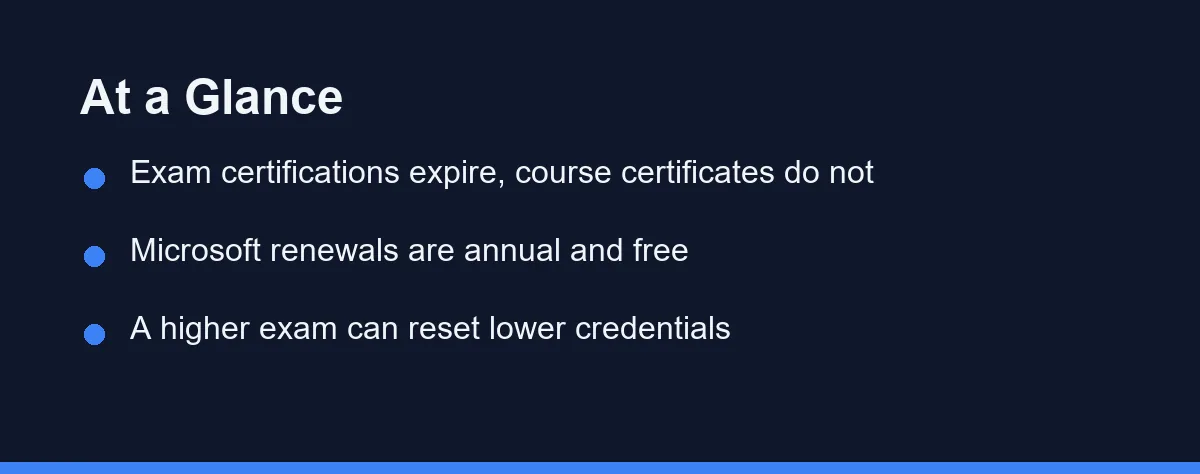
Vendor exam certifications expire. AWS, Google Cloud, Cisco, CompTIA, and the role-based Microsoft credentials all carry a validity period, typically one to three years. They certify current knowledge of a product that ships changes constantly, so the clock exists for a reason.
Course completion certificates do not expire. Anything you earn by finishing material on Coursera, edX, Udemy, or LinkedIn Learning stays valid forever, including the Google Career Certificates. Those records confirm that you completed a curriculum on a date, and no vendor revisits that fact.
The renewal method matters more than the length of the cycle. A free online assessment once a year is far lighter than a proctored exam every three years, even though the second sounds more relaxed.
Why the Clock Exists
A certification is a claim about what you know right now. Cloud platforms release services and rewrite defaults on a monthly cadence, so a five-year-old credential describes a platform that no longer exists in that form.
Vendors also manage the credibility of their own partner networks. Consulting firms advertise how many certified engineers they employ, and that number means little without an expiry rule behind it.
There is a third reason, and it is commercial. Renewal keeps candidates inside the ecosystem, buying practice material and exam vouchers. That is not a scandal, but it belongs in your cost calculation, alongside the other lines people leave out of the budget.
Course certificates escape all of this because they claim something narrower. A completion record says you finished a syllabus, which stays true regardless of what the platform ships next year.
Validity Cycles for the Credentials People Ask About
The table covers the credentials people ask about most. Cycles and rules shift, so treat this as a starting map and confirm the specifics on each vendor’s official certification page.
| Provider | Typical validity | How renewal works | Fee pattern |
|---|---|---|---|
| AWS | 3 years | Pass the latest exam or, in some tracks, a higher-level exam; Skill Builder subscribers can also maintain for 1 year | Exam fee, often with a 50% discount voucher |
| Microsoft role-based | 1 year | Free unproctored assessment on Microsoft Learn, in the window before expiry | No fee for the renewal assessment |
| Microsoft Fundamentals | Does not expire | None required | None |
| Google Cloud | 2 years for Professional, 3 for Associate | Retake the current exam | Exam fee |
| CompTIA | 3 years | Continuing education credits plus a CE fee, or a higher exam | CE fee per cycle plus credit costs |
| Cisco | 3 years | Exam, or continuing education credits | Exam fee or credit activity |
| PMI (PMP) | 3 years | Professional development units plus a renewal fee | Renewal fee, lower for members |
| Coursera and edX certificates | No expiry | None | None |
Two rows deserve a second look. The Microsoft annual cycle sounds punishing until you notice the renewal is a free online assessment you can take at your desk. The CompTIA row looks generous at three years until you account for the CE fee and the credit paperwork.
The last row is the quiet advantage of course platforms. It is also why a completion certificate carries less weight with employers, since nothing forces you to keep it current.
What Lapsing Actually Costs
An expired credential does not vanish from your history. The vendor keeps the record, the verification link changes state, and your profile stops listing the credential as active.
The practical damage depends on who is checking. Employers running a partner program need active credentials on staff, so an expired badge can genuinely block a role or a contract requirement.
For everyone else, the damage is milder and mostly reputational. A resume listing an expired certification without a date invites the question of what else is out of date.
Re-earning is the usual remedy, and it means paying the current exam fee and studying the current objectives. That is the real cost of a lapse, because exam blueprints drift substantially over a three-year gap.
How to Choose What to Maintain

Start by counting the credentials you already hold and their renewal dates in one place. Most people underestimate the total, because each one arrived in a different year.
Then ask what each credential is doing for you today. A certification that appears in job postings you actually want is worth maintaining, and one you earned for a role you left is not.
Weigh the renewal mechanics against your working style. If your job already involves conferences, internal training, or writing documentation, a continuing education path converts work you do anyway into credits. If your week is pure delivery, a single exam every few years may be simpler than tracking credits.
Watch for stacking rules, since they are the cheapest maintenance available. Passing a professional-level exam frequently renews the associate-level credential underneath it, which means one study effort covers two lines on your profile.
Finally, decide how deep to go with one vendor before adding another. Two current credentials in one ecosystem read as depth, and five expired ones across four vendors read as churn. Our AWS versus Azure certification comparison covers that first choice in more detail.
Who Should Renew Which Credential
Career changer with a first cloud certification: Renew it once, then decide. The first renewal is cheap evidence that you stayed in the field, which matters most while your work history is thin. If you land a role using a different platform, let the old credential lapse without guilt.
Consultant at a partner firm: Maintain everything your firm’s partner tier requires, and treat the deadlines as billable planning. Ask whether the employer covers exam fees and maintenance charges, because many do and few advertise it.
Developer whose employer pays for exams: Choose the vendor your production stack uses, and schedule renewals in the quiet season. Use the higher-exam stacking rule when it exists, since your employer funds the upgrade and the renewal at the same time.
Student building a first resume: Prefer credentials with long or no expiry until you have income. Course certificates and fundamentals-level exams cost less to hold, and they still demonstrate direction. Our guide on listing an online course on your resume covers the phrasing.
Manager who no longer works hands-on: Let deep technical credentials lapse and keep one broad credential current if your role requires it. Nobody expects an engineering manager to hold a current specialty certification, and pretending otherwise wastes weekends.
Contractor bidding on public sector work: Read the tender requirements before deciding anything, because some contracts name specific active certifications. In that case the renewal is a business expense with a clear return, not a personal development question.
Three Cost Lines, Only One Obvious
Certification costs arrive in three separate lines, and only the first is obvious. There is the exam fee, the maintenance or renewal fee, and the study material.
| Cost line | When it appears | How to reduce it |
|---|---|---|
| Initial exam fee | Once per credential | Vendor promotions, employer reimbursement |
| Renewal exam fee | Each cycle, exam-based vendors | Stack a higher exam that renews lower ones |
| Annual maintenance fee | Yearly, credit-based vendors | Bundle multiple credentials under one fee where allowed |
| Continuing education | Ongoing | Count conference sessions and internal training you already attend |
| Practice material | Before each attempt | Official free tiers, employer learning budgets |
Exact figures change by region and by vendor promotion, so confirm current pricing on the official site before you budget. Prices quoted in forum posts are frequently a year or two stale.
The larger expense is time. A renewal assessment costs an afternoon, and a full re-examination costs several weekends of preparation. Count that before you collect a fourth or fifth credential you intend to keep current.
Tracking Renewal Dates Without a Spreadsheet Habit
Most lapses happen for a boring reason. The reminder email lands in a promotions folder eleven months after you stopped thinking about the credential.
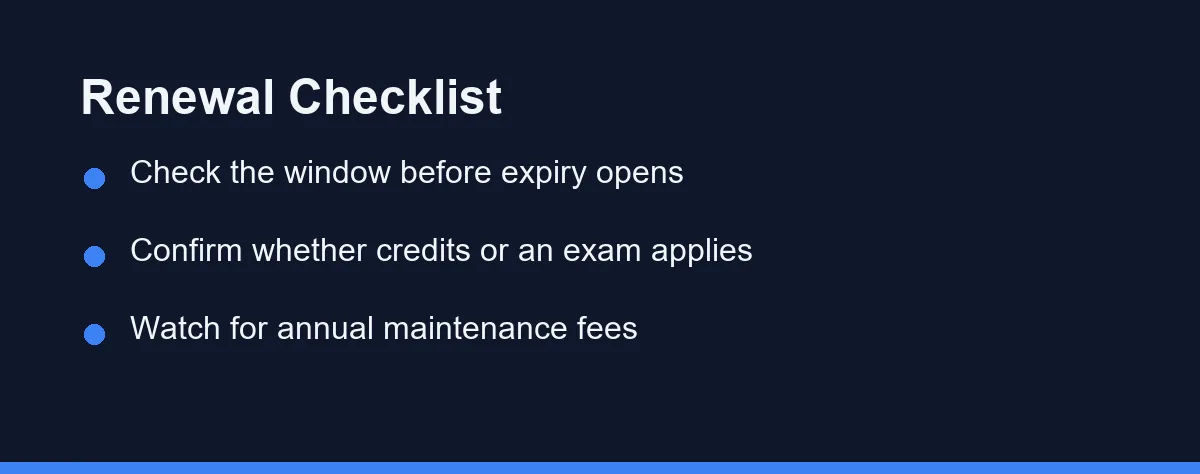
Start with the calendar rather than a tracking app. Create two entries per credential, one at the expiry date and one at the point where the renewal window opens, which is often six or twelve months earlier. The second entry is the one that saves you, because several vendors reject early attempts.
Use a credential wallet as the source of truth. Credly hosts badges for many vendors and shows expiry states in one view, and vendor portals such as AWS Certification and Microsoft Learn keep their own authoritative records. Checking one page each quarter beats trusting five separate email streams.
Tell your employer’s learning system as well, when one exists. Companies that reimburse exam fees usually track expiry dates for partner reporting, and their reminders arrive through a channel you actually read.
Finally, write the renewal method next to each date, not only the deadline. Discovering in the final week that a credential needs sixty development units rather than an afternoon assessment is the version of this mistake that costs the most.
Missing the Renewal Window Entirely
Missing the renewal window is the most common and the most avoidable. Several vendors open renewal only within a set period before expiry, so both early and late attempts fail.
Assuming every credential in a family follows one rule causes trouble too. Fundamentals-level exams often never expire while role-based exams in the same catalogue renew annually.
Listing certifications without dates is a small habit with real cost. A hiring manager who checks the verification link and finds an expired badge reads the omission as a choice.
Collecting credentials faster than you can maintain them is the expensive version of the same error. Each new certification adds a permanent renewal obligation, and the obligations compound quietly.
Current Knowledge Is What Expires
Exam-based certifications expire because they certify current product knowledge, and course completion certificates do not because they certify a finished syllabus. Knowing which kind you hold removes most of the confusion.
Map your renewal dates once, in one calendar, and the rest becomes routine. The Microsoft annual assessment costs an afternoon, and the three-year exam cycles reward the stacking rules that renew lower credentials automatically.
Maintain the credentials that appear in the jobs you want, and let the rest lapse deliberately rather than by accident. A short list of current credentials tells a clearer story than a long list of expired ones.
CompTIA is where that calculation gets closest, and CompTIA renewal: continuing education vs retaking the exam prices both routes over a full three-year cycle.
Some credentials avoid the clock entirely. Microsoft Applied Skills vs a certification compares a credential that never expires against one that renews every single year.
Most of these schemes measure continuing education in units that look interchangeable and are not. What a CEU is and who needs one untangles CEUs, PDUs and CPE credits before you pay for a course that will not count.
Agile credentials split along the same line. The PSM I and CSM comparison sets a lifetime Scrum certification against one that renews every two years for $100 and 20 education units.
Expiry and exam retirement are separate clocks that candidates routinely merge into one worry. A retired exam version leaves the credential itself untouched, and what happens when CompTIA retires an exam sets out which clock is actually running.
FAQ
Do Coursera and Google Career Certificates expire like AWS certifications?
No. A course completion certificate from Coursera, edX, or Udemy records that you finished the material, and nothing revokes it. Vendor exam certifications such as AWS, Microsoft, and CompTIA are different, because they certify current knowledge of a product that keeps changing. Only the second kind carries a renewal date.
What happens if you let a certification lapse?
The credential moves to an expired state and stops counting as active on the vendor's verification page. Your exam history stays in the account, and most vendors let you re-earn the credential by passing the current exam. You cannot renew it quietly after the deadline, so calendar the date the day you pass.
Can a higher-level exam renew a lower certification automatically?
Yes, and it is one of the better-value rules in the whole system. At several vendors, passing a higher-level exam resets the clock on the lower ones in the same family. That turns a planned upgrade into free maintenance. Confirm the current policy on the vendor page before you rely on it.
Should you put an expired certification on your resume?
List the credential with the year you earned it, and add the expiration only when the credential is still active. An expired certification is worth mentioning under training rather than under certifications. Recruiters check the verification link more often than candidates expect.
Is continuing education better than retaking the exam?
Continuing education suits people who attend conferences, publish, or train others, since those activities already generate credits. Retaking the exam suits people whose daily work has drifted from the certified product. The credit path costs less money and more paperwork, and the exam path is the reverse.
Sources
- AWS Certification: Recertification — checked 2026-10-15
- Microsoft Learn: Microsoft Certification Renewal — checked 2026-10-15
Some links may be affiliate links. We may earn a commission at no extra cost to you.
How this article was made: it was drafted with AI assistance from the official sources listed above, and its figures were checked against those pages on the dates shown. It is not based on personal hands-on testing.
Comments
Post a Comment