Coursera Plus vs Paying Per Course: Which Is Worth It for Career Changers?
The Fork Every Career Changer Hits
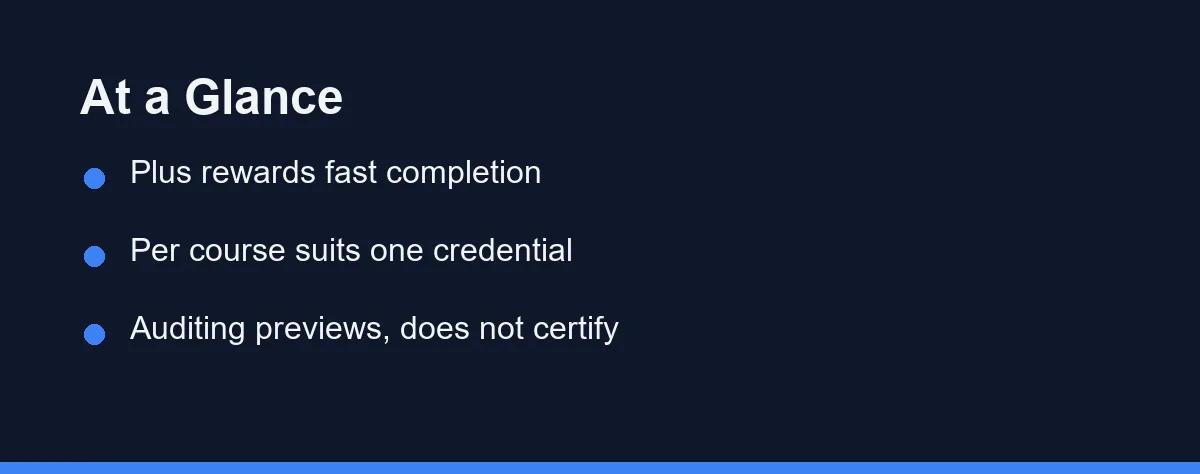
For most career changers, paying per course beats Coursera Plus, because one target certificate is paid for once and finished. Subscribe to Plus only if you will genuinely complete two or more paid credentials inside the term. A learner who stacks a data certificate and a Python specialization in one year is the person it suits.
The subscription looks like obvious value. Coursera says Plus unlocks more than 10,000 courses, Projects, Specializations, and Professional Certificate programs for a flat fee. That reads well next to a single certificate at a comparable price, but it hides the real variable.
Subscriptions bill by time. Certificates are earned by finishing work. The deal only pays off at a pace most learners never hit.
Audit first in either case. Auditing costs nothing and reveals whether the instructor and pace suit you. It prevents the most expensive mistake in online learning, which is buying access you never use. Our comparison of Coursera financial aid vs auditing free explains which free route fits which goal.
Four Ways to Pay, and What Each Withholds
Four access routes exist, and career changers routinely use more than one. Knowing what each withholds is the key.
Audit Access
Auditing unlocks lectures and most readings without payment. It is the correct first step for every course you are considering.
The strength is zero risk. You confirm the teaching style, the assumed background, and the actual workload before committing money.
The limitation is that graded work, peer feedback, and the certificate stay locked. Auditing tells you whether to buy, but it produces nothing you can put on a resume.
Single Course or Certificate Purchase
Buying one Professional Certificate is the standard career-change path. The Google, IBM, and Meta certificates all work this way, and most bill monthly until you finish.
The strength is alignment with one goal. You pay for the credential you named in your plan and nothing else.
The trade-off is that slow progress raises the total, since these certificates bill by month rather than as a single fee. Finishing in four months rather than eight halves the cost.
Coursera Plus Subscription
Plus comes in monthly and annual forms, with the annual version priced well below twelve monthly payments. It covers most standalone courses and many specializations.
The strength appears when you stack credentials. A learner completing a data analytics certificate and then a Python specialization inside one year extracts clear value.
The trade-off is the completion assumption. Industry completion rates for open online courses sit in the single digits, and the subscription is priced with that in mind.
Financial Aid and Employer Sponsorship
Coursera’s aid program and employer learning budgets sit outside the pricing debate entirely. Both routinely cover the full cost.
The strength is obvious. Approved aid removes the decision, and many employers fund upskilling that is loosely job-adjacent.
The trade-off is process. Aid applications take time to review and apply to one course at a time, so plan several weeks ahead of your intended start.
The table lines up the four routes against what a career changer needs. Read it against your own timeline.
| Factor | Audit | Single Certificate | Coursera Plus | Financial Aid |
|---|---|---|---|---|
| Cost | Free | Per credential | Flat subscription | Free if approved |
| Certificate issued | No | Yes | Yes | Yes |
| Graded assignments | No | Yes | Yes | Yes |
| Catalog access | Wide, view only | One credential | Most, with exclusions | One course at a time |
| Rewards fast finishing | Not applicable | Yes | Strongly | Neutral |
| Best fit | Previewing | One target job | Multi-credential plan | Budget constrained |
The pattern is consistent. Every paid route rewards speed, and the subscription rewards it most aggressively. That reframes the question from which option is cheaper to how many credentials you will realistically finish in the next twelve months.
What Plus Leaves Out, and What Closes When It Lapses
Verify inclusion rather than assuming it. Coursera Plus covers a large slice of the catalog but excludes degree programs, MasterTrack modules, and selected partner content. One excluded course in your planned sequence can undo the entire subscription case.
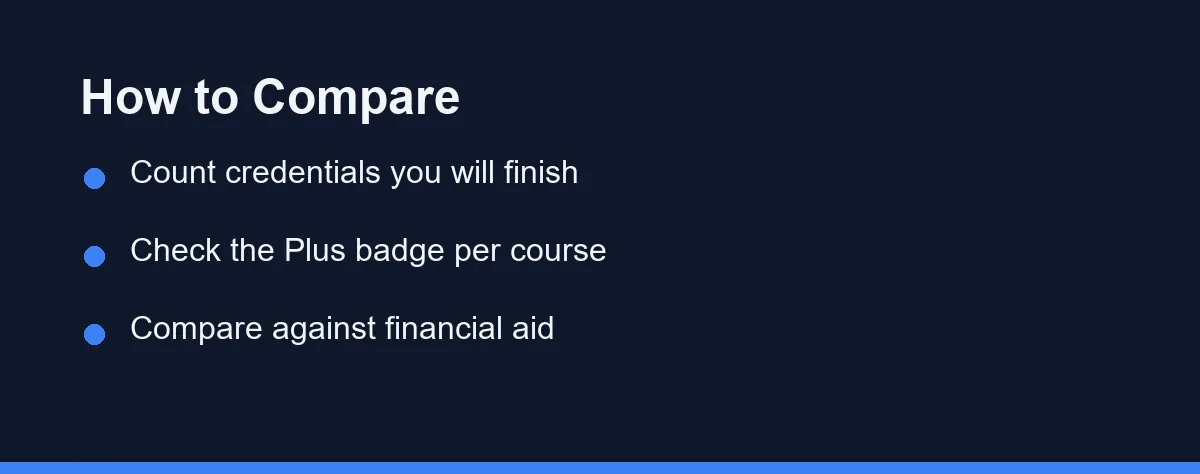
Discovering that your third planned course sits outside Plus, after you have paid annually, is a costly and entirely avoidable surprise. The Plus badge appears on the individual course page, so check every item in your sequence before you subscribe.
Access rules after the term ends matter just as much. Certificates you have earned remain verifiable, but course materials from a lapsed subscription generally close to you.
Learners who expect to revisit lecture notes months later should download key resources while enrolled. Slides, datasets, and reading lists are the usual casualties.
Your Weekly Hours Set the Real Price
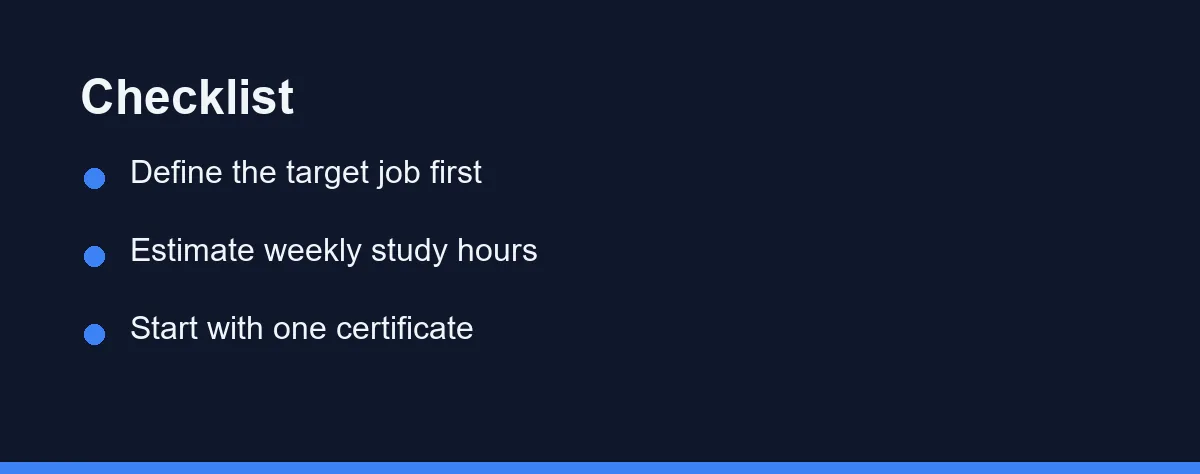
Estimate your realistic weekly hours, not your hopeful ones. A Professional Certificate typically advertises three to six months at roughly ten hours per week. Halving that pace doubles the calendar time, and the subscription keeps billing throughout.
Name the target job first, then work backward to the credential. A career changer aiming at a junior data analyst role needs one recognized certificate and a portfolio, not six unrelated course completions.
Job listings in data analytics, IT support, and project management frequently name specific Professional Certificates, while generic course completions carry far less weight. Our guide on Google career certificates covers how hiring managers treat those. Employers screening career changers also respond to applied projects more than to completion counts, so a certificate that includes capstone work carries more weight.
Account for the season you are starting in. Beginning a six-month certificate three weeks before a demanding period at your current job almost guarantees a stall, and a stalled certificate keeps billing. Starting a month later with clear time is usually cheaper in total.
Think about how you learn, too. Coursera’s structure suits people who want deadlines, peer review, and a fixed sequence, while self-directed learners often move faster on a library-style platform. Our comparison of Coursera and Udemy covers when a one-time purchase elsewhere serves better.
Financial Aid Is the Line Item Most Learners Skip
Check financial aid eligibility before comparing prices at all. Coursera grants aid on many individual courses through an application that asks about income and educational goals. Approved learners pay nothing for that course, which changes the comparison completely for anyone on a tight budget.
Many learners overlook this because the application sits behind a small link on the enrollment page rather than in the main pricing view. It is easy to miss on a phone screen.
Do not skip the application because approval looks unlikely. Aid applies to one course at a time and takes time to review, so start several weeks before your intended start date.
Employer learning budgets deserve the same early check. Asking your manager to fund a named certificate costs you nothing, and a specific program is usually easier to approve than an open-ended subscription.
What It Costs at the Time of Writing
As of October 2026, Coursera lists Plus at $59 a month or $399 a year. The annual version assumes sustained use across the year. The monthly plan offers a 7-day free trial, and the annual plan carries a 14-day money-back guarantee. Coursera’s terms add that certificates cannot be earned during the free trial.
Professional Certificates generally bill monthly after a short trial period, so the total depends directly on how long you take. A certificate advertised at six months costs roughly twice a three-month completion.
Compare total cost to finish rather than cost per month. Estimate your weekly hours, convert that into months, and multiply. That single calculation resolves most of these decisions without further debate.
Prices, trial lengths, and plan structures all change without notice. Confirm current pricing on the official Coursera site before you enroll, as of 2026.
Which Route Fits Your Plan
The arithmetic changes completely with your plan and your available hours. Here is how the choice lands in five concrete situations.
The career changer chasing one job title: Pay per course. Buy the single Professional Certificate the job listings name, set a completion date, and stop. The subscription only adds pressure to consume courses that will never appear on your resume.
The learner with ten or more study hours per week: Coursera Plus starts to make sense, because you can realistically finish two credentials inside a year. Write both target certificates and their dates down before you subscribe. If you cannot name the second one, you are buying browsing access rather than skills.
The employed professional with a learning budget: Ask your employer to fund the specific certificate before comparing personal prices. Many companies approve upskilling that is loosely job-adjacent, and the request costs you nothing. Employer sponsorship usually covers a named program more easily than an open-ended subscription.
The learner on a tight budget: Apply for Coursera financial aid on the individual course first. Approval reduces the cost to nothing, and the application sits behind a small link on the enrollment page. Aid applies to one course at a time, so start several weeks before you plan to begin.
The undecided browser exploring several fields: Audit rather than subscribe. Free auditing gives you lectures and readings across as many courses as you want, which is exactly what exploration needs. Convert to a paid route only once one field holds your attention for a full month.
Where the Money Leaks, and How to Plug It
A few habits waste more money than any pricing choice. They are simple to prevent, and each one has a direct fix.
Do not subscribe before finishing anything. Prove you can complete one credential at your real pace, then decide whether volume access helps.
Do not enroll in six courses at once. Parallel enrollment feels productive and reliably produces six abandoned courses.
Do not confuse a course certificate with a Professional Certificate. Employers recognize the named programs, and a single-course completion carries much less weight in screening.
The subscription and the single purchase serve different plans rather than different budgets. Career changers should default to the single credential, because it matches how hiring actually works. Audit before paying, apply for aid before assuming you must pay, and write completion dates before choosing any plan.
For related planning, see our guides on Coursera vs Udemy and the official Coursera Plus terms published by the platform.
Specializations are the bundles many people use Coursera Plus to reach, and they have a direct rival outside the platform. Udacity Nanodegree vs Coursera Specialization sets reviewed projects against university-branded course bundles.
Whichever plan you choose, you can stop paying between study blocks without losing your work. What happens to your Coursera progress if you cancel covers the timing, the refund window, and the certificate catch.
FAQ
Is Coursera Plus cheaper than buying courses individually?
Coursera Plus is an annual or monthly subscription that unlocks most of the catalog, while per-course payment charges you for one course or one Professional Certificate at a time. The subscription pays off only when you finish several paid items within the same term, so completion speed decides the value more than the sticker price does.
Does Coursera Plus include everything on the platform?
No. Coursera says the majority of courses are included, but degree programs, MasterTrack certificates, and certain courses, Specializations, and Professional Certificate programs are excluded. Check the specific course page for the Plus badge before assuming it is included.
Can I just audit courses for free instead?
Auditing gives you the video lectures and most readings at no cost, but withholds graded assignments, peer review, and the certificate. For a career change where you need proof of completion, auditing works as a preview rather than a substitute.
Is there a refund window on Coursera Plus?
Coursera advertises a refund window on Plus subscriptions, counted in days from the purchase date rather than from your first lesson. Monthly and annual plans can carry different terms, and a refund is generally void once you have earned a certificate under the subscription. Read the refund policy shown at checkout before paying, since the window is short and easy to miss. Confirm the current terms on the official Coursera site.
Can I switch from paying per course to Coursera Plus later?
Yes, and many learners upgrade after finishing one credential and deciding to stack a second. Coursera does not normally credit what you already paid toward the new subscription, so the switch starts a fresh billing cycle. The efficient move is to finish the current certificate first, then subscribe on the day you begin the next one. Confirm the current upgrade rules on the official Coursera site before switching.
Sources
- Coursera: Coursera Plus — checked 2026-10-15
- Coursera: Terms of Use — checked 2026-10-15
Some links may be affiliate links. We may earn a commission at no extra cost to you.
How this article was made: it was drafted with AI assistance from the official sources listed above, and its figures were checked against those pages on the dates shown. It is not based on personal hands-on testing.
Comments
Post a Comment