Coursera Financial Aid vs Auditing a Course Free
Three Doors Lead Into the Same Classroom
The enrollment page presents one obvious button and hides two alternatives. Most learners click the obvious one and pay, or close the tab and learn nothing.
The same course content sits behind three doors on Coursera. You can audit it at no cost, apply for financial aid that waives the fee entirely, or pay through a single purchase or a subscription.
These routes are not ranked versions of each other. They deliver genuinely different things, and the right one depends on whether you need the knowledge, the credential, or both.
This guide explains what each route includes, how the aid application actually works, and how to pick without wasting either money or a month of waiting.
The Certificate Is the Only Real Difference
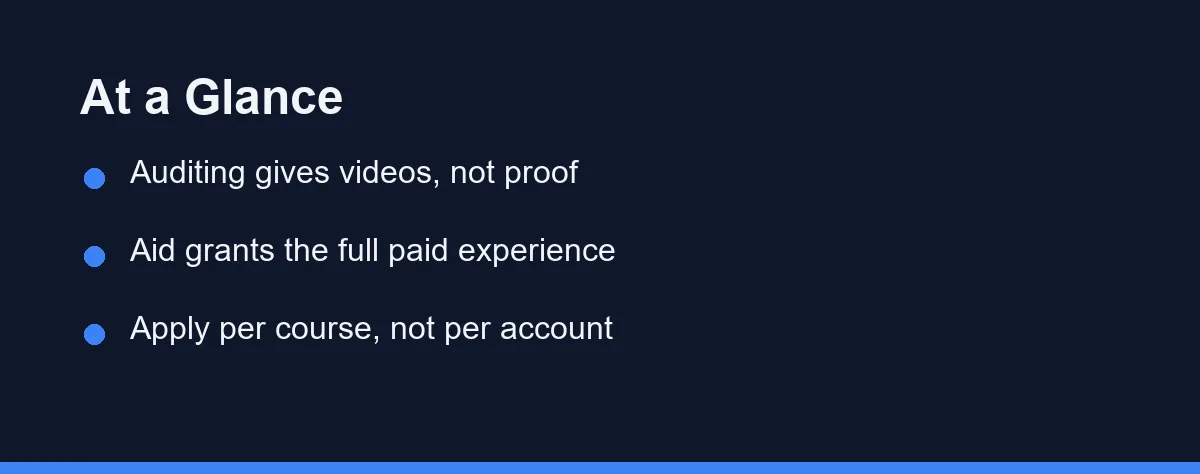
Audit the course when you want the knowledge, and apply for financial aid when you need the certificate but cannot justify the fee. Pay directly when you need the certificate quickly and the amount is affordable.
Content access is nearly identical across all three routes. Lectures, readings, and most course materials appear for auditors, so the learning itself is rarely what you are buying.
What you buy is assessment and proof. Graded assignments, peer-reviewed projects, and the shareable certificate belong to the paid experience, and financial aid grants that same experience without the payment.
What Auditing Actually Gives You
Auditing sits behind a small link on the enrollment page rather than a button, which is why many learners never find it.
Lecture videos and readings open immediately in most courses. For a learner who wants to understand a topic before committing, that access answers the question at zero cost.
Graded work stays locked. Quizzes and programming assignments either disappear or become ungraded practice, and peer-reviewed projects are unavailable, so no completion record exists at the end.
Availability varies by course. Some professional certificate programs restrict auditing or limit it to the first course, so check the enrollment page for the specific program rather than assuming.
Auditing works best as a filter. Sitting through the first two weeks tells you whether the instructor’s pace and level fit you, and our guide to free versus paid online courses covers when free access is genuinely enough.
How Financial Aid Works and What It Asks
Coursera operates a financial aid program that waives the course fee for approved applicants, and the approval grants the complete paid experience including the certificate.
The application sits on the same enrollment page as the payment option. It asks about your annual income, your educational background, why you want to take this specific course, and how you plan to apply what you learn.
Coursera states that applications go through a review period before a decision arrives, so apply ahead of the session you want rather than on the day it opens. Confirm the current review timeline on the official help pages, since it changes.
The application is per course. A Specialization made of five courses requires five separate applications, each reviewed on its own, which reshapes how you sequence a multi-course program.
Approval carries no cost and no obligation, and a rejected application can be revised and submitted again. The written answers carry the decision, and short generic responses are the common failure.
The Four Routes Side by Side

The table compares what each route delivers. Verify current terms on the platform itself before you commit, since program rules change and this reflects the structure as of 2026.
| Route | Cost | Graded assignments | Certificate | Wait before starting | Best for |
|---|---|---|---|---|---|
| Audit a single course | Free | No | No | None | Learning a topic without needing proof |
| Coursera financial aid | Free after approval | Yes | Yes | Review period per course | Job seekers who need the credential |
| Single course purchase | One-time fee | Yes | Yes | None | One specific course needed soon |
| Coursera Plus subscription | Recurring fee | Yes | Yes | None | Several courses within one period |
| edX audit track | Free | Limited | No | None | Comparing a university-led alternative |
| edX verified track | One-time fee | Yes | Yes | None | University-branded proof of completion |
The fourth column drives most decisions. If nobody will ever ask to see a certificate, three of these routes are simply more expensive versions of auditing.
The fifth column decides between aid and payment. A hiring deadline four weeks away leaves room for an application, while one that lands next week does not.
For a closer look at the subscription math, see our comparison of Coursera Plus and paying per course, and for the platform-level differences see Coursera versus edX on edX.
Where the Certificate Actually Matters
The certificate carries real weight in some situations and almost none in others, and knowing which you are in prevents overspending.
It matters for career changers without relevant work history. A recruiter scanning an application for evidence of commitment treats a completed program as a signal, especially in data, cloud, and project management fields.
It matters for internal advancement. Employers with training budgets and formal development plans often require documented completion, and many will reimburse the fee, which removes the question entirely.
It matters less for developers and designers with a portfolio. Working code and shipped projects outrank any completion record, as our guide to certificates versus portfolio projects explains.
It matters least for personal interest. Learning statistics to understand your own data is a goal that no certificate improves.
What You Pay When Aid Is Not an Option
As of October 2026, Coursera lists individual courses at $49 to $79 a month on its Coursera Plus page. The Plus subscription itself costs $59 a month or $399 a year. Professional certificate programs and Specializations bill monthly until you finish, so check the course page for the current figure.
The subscription structure creates a timing effect that catches people out. Monthly billing rewards fast completion and punishes a slow pace, so a learner who takes six months pays several times what a focused learner pays for the identical certificate.
Employer reimbursement changes the calculation entirely, and many people never ask. Our guide to getting an employer to pay for an online course covers how to frame that request.
Watch the total cost of a Specialization rather than the monthly figure. Five courses at a monthly rate becomes a meaningful sum, and financial aid applied course by course removes it. If you buy a single course outright, Coursera’s terms say you may get a full refund if you cancel within 7 days of payment.
How to Write the Application Answers
The aid decision rests almost entirely on three written answers, and most applicants treat them as a formality.
The income question wants context rather than a bare figure. State your situation plainly, including student status, unemployment, caregiving, or a currency where the course fee represents a significant share of monthly income.
The motivation question wants a specific plan rather than enthusiasm. “I want to learn data analysis” says nothing, while “I handle reporting for a small logistics firm and need SQL to replace three manual spreadsheets” describes an outcome a reviewer can picture.
The application question wants the step after the course. Name the job title you are targeting, the project you intend to build, or the internal role you plan to apply for, and say when.
Length matters less than specificity, though two or three sentences per answer is a reasonable target. Concrete nouns beat adjectives everywhere in this form.
Write the answers in a separate document first, then adapt them for each course in a Specialization. Reviewers see many applications, and the ones describing a real situation stand out without any exaggeration.
Which Route Fits Your Goal
Start from what you need at the end, then work backward to the route.
The curious learner exploring a new field: Audit. You get the lectures at no cost and no application, and you can upgrade later if the subject holds your interest.
The job seeker who needs a credential on a limited budget: Apply for financial aid, and start with the first course of the Specialization rather than all five. Approval on that first course confirms the process works before you invest more time.
The employed professional with a training budget: Pay directly, and request reimbursement. The review period for aid is time that a funded learner has no reason to spend.
The learner planning several courses this quarter: Compare the subscription against per-course purchases using your realistic pace. Anything under three courses in the period usually favors buying individually.
The learner unsure whether the course is any good: Audit for one week first, then decide the payment question. Applying for aid on a course you abandon wastes a review slot and your own time.
Application Mistakes That Get Aid Denied

Writing two-sentence answers is the most common one. The reviewer looks for a specific plan, and vague statements about self-improvement give them nothing to approve.
Copying the same text into several applications is the second. Each course has a different purpose in your plan, and the answers should reflect that difference clearly.
Applying after the session begins is the third. The review period runs on its own schedule, so a late application can leave you outside the cohort you wanted.
Overstating your circumstances is the fourth and the most damaging. The program asks for honest financial context, and inflated claims risk your standing on a platform you may use for years.
Finally, avoid treating rejection as final. Rewriting the answers with concrete detail about the job or task you are preparing for is a legitimate and frequently successful second attempt.
Match the Route to Why You Enrolled
The choice between auditing, aid, and payment is not a budgeting question first. It is a question about what you need to exist at the end of the course.
If the answer is knowledge, audit and keep the money. If the answer is proof, aid gives the same outcome as payment for the cost of a well-written application and some patience.
If the answer is proof on a deadline, pay, and ask your employer to cover it before you assume the cost is yours.
Whichever route you take, finishing matters more than the credential. An abandoned paid course and an abandoned audit produce exactly the same result on a resume.
FAQ
What exactly do you get when you audit a Coursera course for free?
Auditing gives access to lecture videos and most readings at no cost, and it omits graded assignments, peer review, and the certificate. It suits anyone learning a skill for its own sake. It does not suit anyone who needs proof of completion for an employer or a visa file.
Does Coursera financial aid include the certificate?
Financial aid covers the full course fee and grants the same graded assignments and certificate that a paying learner receives. Coursera reviews applications before granting them, and the review takes time, so apply well before you plan to start. Approval is per course rather than per account.
Can financial aid cover a whole Specialization at once?
Each course inside a Specialization requires its own application, which is the detail that surprises most applicants. A five-course Specialization therefore means five separate approvals and five waiting periods. Plan the sequence rather than applying to everything at once.
Why do financial aid applications get rejected?
The application asks about your income, your reason for taking the course, and how you plan to use it. Short or copied answers are the common reason for a rejection, since the reviewer is looking for a specific plan. Rewriting with concrete detail and reapplying is allowed.
Is a Coursera Plus subscription better than paying per course?
Only if you intend to finish several courses within the same subscription period, because the value comes from volume rather than from any single certificate. A learner taking one course a year pays less by buying that course outright. Compare your realistic pace, not your ambition.
Sources
- Coursera: Coursera Plus — checked 2026-10-15
- Coursera: Terms of Use — checked 2026-10-15
Some links may be affiliate links. We may earn a commission at no extra cost to you.
How this article was made: it was drafted with AI assistance from the official sources listed above, and its figures were checked against those pages on the dates shown. It is not based on personal hands-on testing.
Comments
Post a Comment