Coursera vs edX: Which Is Better for University-Level Learning?

Introduction
When you want serious, university-level learning online, two names rise to the top. Coursera and edX both partner with respected universities and offer courses far beyond a casual tutorial. The choice between them is not obvious.
Both platforms grew from the same academic wave, yet they feel different in practice. One leans harder into formal university structure. The other balances academic depth with job-ready professional skills.
That difference matters because your goal shapes the right fit. A learner chasing a degree-style experience has different needs than one building a specific career skill. Picking by brand alone often leads to the wrong course.
This guide compares Coursera and edX in plain, practical terms. We look at catalog focus, university partners, certificates, cost, and free options. By the end, you will know which platform matches your learning goal.
Quick Answer
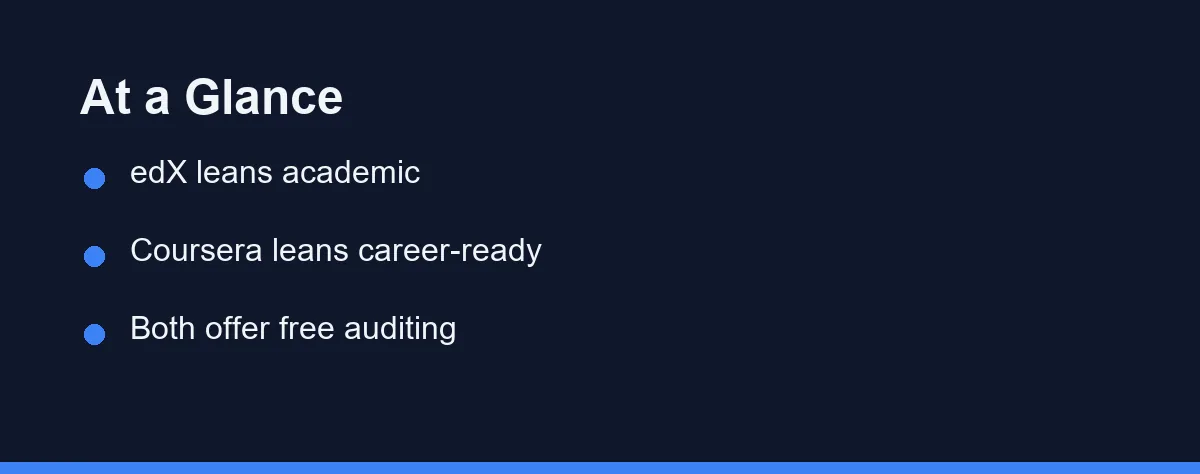
For strictly academic, university-style learning, edX often feels like the closer fit. For a mix of academic depth and career-ready certificates, Coursera usually offers the broader catalog. Both are reputable, so your specific goal decides the winner.
edX, founded by MIT and Harvard, leans into rigorous university content. Its catalog includes many courses that mirror on-campus material and academic structure. Learners seeking that formal, degree-adjacent feel gravitate toward it.
Coursera partners with a wide range of universities and companies. Alongside academic courses, it offers professional certificates aimed squarely at employability. That blend makes it strong for career pivots and job-focused skills.
The honest answer is that neither dominates outright. edX edges ahead on pure academic feel, while Coursera edges ahead on career breadth. Auditing a course on each is the fastest way to feel the difference.
What to Look For
Start with your learning goal. Academic depth, a career skill, and a formal credential are different targets. The platform that best serves one may only loosely serve another.
Next, examine the catalog in your subject. Both platforms are strong in tech, business, and data, but depth varies by topic. Browse actual course listings rather than trusting a general reputation.
Consider the university and partner mix. edX built its name on MIT and Harvard roots and heavy academic partnerships. Coursera spreads across many universities plus major companies offering job-focused programs.
Look closely at certificates and their recognition. Both offer paid certificates, and both offer more formal credentials and even degrees. What matters is whether your target employer or field values the specific credential.
Check the free options before paying. Both platforms let you audit many courses at no cost, unlocking lectures and readings. Our guide to Coursera vs Udemy covers how Coursera’s pricing model compares more broadly.
Finally, weigh the learning format that suits you. Some learners thrive on structured, cohort-style university courses, while others prefer flexible self-pacing. Matching format to your habits keeps you finishing what you start.
Top Options
Learners usually approach these platforms with one of three goals. Each goal points toward a different way of using Coursera or edX. Treat these as starting points, not fixed rules.
Academic Depth and Rigor
If you want a course that feels like a university class, edX is a natural first stop. Its roots at MIT and Harvard shaped a catalog rich in rigorous, structured content. Many courses mirror on-campus material closely.
Coursera also offers strong academic courses from top universities. The difference is emphasis: edX leans more consistently academic, while Coursera mixes in career-focused programs. For pure rigor, edX often feels closer to the classroom.
Career Skills and Certificates
If your goal is a job-ready skill or a resume boost, Coursera’s breadth shines. Professional certificates from companies and universities target specific roles directly. These programs are built around employability rather than pure theory.
edX offers professional and MicroBachelors-style options too, so it is not absent here. But Coursera’s catalog of career certificates is generally wider. For a focused career pivot, that selection is a real advantage.
Formal Credentials and Degrees
Both platforms go beyond single courses into stackable credentials and full online degrees. edX offers MicroMasters and university degree pathways, while Coursera offers specializations and degrees too. These suit learners who want a recognized, structured qualification.
The right pick depends on the specific program and its issuing university. A degree’s value comes from the institution behind it, not the platform hosting it. Research the actual university and credential before committing time or money.
Feature Comparison

The table below summarizes how Coursera and edX compare on the factors that matter most. Use it as a quick reference, not a final verdict. Your goal and subject still come first.
| Factor | Coursera | edX |
|---|---|---|
| Catalog emphasis | Academic plus career certificates | Strongly academic and university-style |
| Founding roots | Stanford professors, many partners | MIT and Harvard |
| Certificates | Wide range of professional certificates | Professional and MicroMasters options |
| Free auditing | Available on many courses | Available on many courses |
| Degrees | Full online degrees offered | Full online degrees offered |
| Best for | Career skills and job-ready credentials | University-level academic depth |
| Learning format | Self-paced and structured programs | Structured, university-style courses |
| Example partners | Google, university partners | Harvard, MIT, university partners |
The pattern is clear once you scan the rows. edX leans into academic rigor and a university feel, while Coursera balances that with career-ready breadth. Both offer free auditing, so testing each costs nothing.
For a formal, classroom-like experience, edX often wins. For a job-focused skill with a recognized certificate, Coursera’s catalog usually pulls ahead. Your specific goal, not the brand, should settle it.
How to Choose
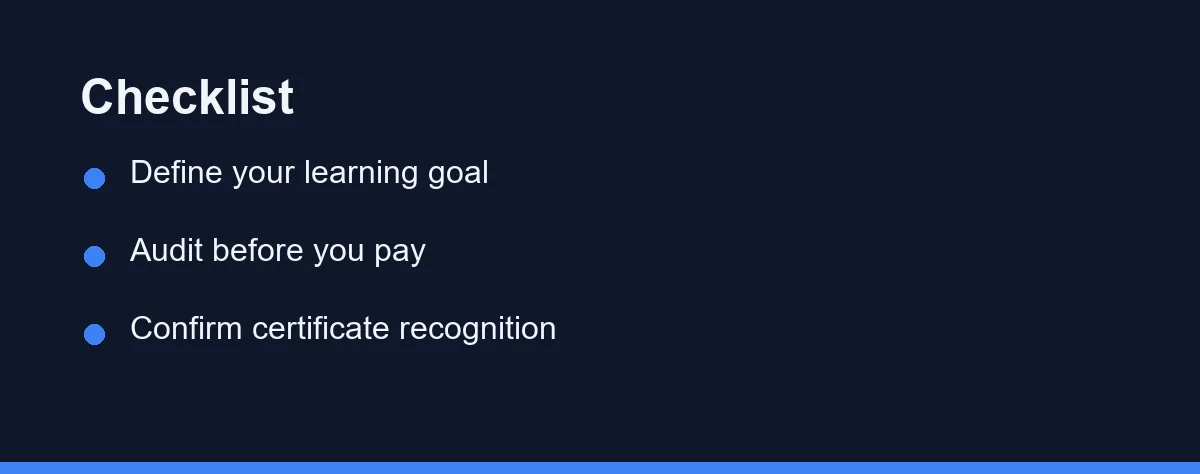
Begin by naming your goal precisely. Academic depth, a career skill, or a formal credential each point to a different fit. A clear goal narrows the choice quickly.
Next, browse the actual courses in your subject on both platforms. Reputation matters less than the real depth available in your topic. A quick scan of listings reveals which catalog serves you better.
Then audit a course on each before paying anything. Free auditing lets you feel the teaching style, pacing, and structure firsthand. That direct experience beats any comparison chart.
Then check certificate recognition for your target field. Ask whether employers or programs you care about value the specific credential. The right certificate is the one that opens the door you want.
Finally, match the format to your habits. If you finish structured, university-style courses, edX suits you well. If you prefer flexible, career-focused programs, Coursera fits. For a wider comparison of career-focused platforms, see our guide on Coursera vs Udemy.
Pricing: What to Expect
Pricing on both platforms varies by course, certificate, and program, so treat any figure as a starting point. Both let you audit many courses free and charge for certificates and full programs. Confirm current pricing on each official site, as of 2026.
Coursera commonly uses per-course fees and a subscription for certain specializations. Some professional certificates bundle several courses under one recurring price. The exact model depends on the specific program you choose.
edX also offers free auditing with paid upgrades for certificates and verified tracks. Its MicroMasters and degree pathways carry larger, university-set costs. Those formal credentials sit well above single-course prices.
Comparing the two, both reward starting with a free audit before you spend. That approach lets you confirm the course fits before paying for a certificate. Neither platform requires payment just to sample the material.
For degrees and stackable credentials, the price reflects the issuing university, not just the platform. Research the total cost and recognition of the specific program. Confirm all figures on the official edX and Coursera sites before enrolling, as of 2026.
Common Mistakes to Avoid
A few missteps waste time and money on either platform. Most are easy to avoid once you notice them.
Do not choose by brand name alone. A platform’s reputation says little about the depth of your specific subject. Browse the actual courses before committing.
Do not pay before auditing. Both platforms let you sample lectures for free, which reveals whether the teaching style fits. Skipping that step risks buyer’s remorse.
Do not assume a certificate replaces a degree. Certificates strengthen a resume and prove focused skills, but they signal initiative rather than a full qualification. Set expectations accordingly with employers.
Do not ignore the completion challenge. Self-paced courses are easy to abandon halfway. Pick a format and schedule you can realistically sustain to the end.
Do not overlook the credential’s recognition in your field. A course only helps your goal if the outcome matters to your target employer or program. Confirm that value before enrolling.
Conclusion
Coursera and edX both deliver genuine university-level learning online, but with different emphases. edX leans into academic rigor and a classroom feel, while Coursera balances academics with career-ready certificates. Neither is best for every learner.
Lean toward edX when you want a formal, university-style experience with academic depth. Lean toward Coursera when you want a job-focused skill and a recognized certificate. Your specific goal should tilt the decision.
Whichever you consider, start by auditing a real course for free on each. That firsthand feel for pacing and structure beats any reputation. Then confirm the certificate’s value for your field before you pay.
Revisit the choice as your goals evolve from learning to credentialing. A skill-building phase and a degree phase call for different tools. For related reading, see our guides on Coursera vs Udemy and Skillshare vs MasterClass.
FAQ
Is Coursera or edX better for university-level courses?
Both are reputable, but edX leans more toward university and academic content, while Coursera balances academic courses with job-ready professional certificates. If you want a degree-style experience, edX feels closer. If you want career skills plus recognized certificates, Coursera has the wider catalog.
Can I use Coursera or edX for free?
Yes, both let you audit many courses for free, meaning you can access lectures and readings at no cost. What you usually pay for is graded assignments, certificates, and full program access. Confirm current audit terms on each official site, as of 2026.
Do Coursera and edX certificates help with jobs?
A certificate from either can strengthen a resume, especially for specific skills and career pivots. It signals initiative and focused learning rather than replacing a degree. Employers value the skills you can demonstrate more than the logo alone.
Some links may be affiliate links. We may earn a commission at no extra cost to you.
This article was written with AI assistance. It is researched and fact-checked, not based on personal hands-on testing unless explicitly stated.
Comments
Post a Comment