Do Online Course Certificates Help You Get a Job?
What a Certificate Signals, and What It Does Not
Yes, an online certificate can help you get a job when it matches the role and has projects behind it. A certificate from a known provider tells a recruiter you finished structured study in the right area. A generic completion badge with nothing behind it does little.
Some learners treat a certificate as a golden ticket, while others call it worthless. The truth sits between those extremes. A certificate signals initiative and foundational knowledge. That signal helps most early in a career or during a field switch.
What it does not do is prove you can perform the work. Employers hire for demonstrated skill, and a badge without evidence behind it falls flat. Projects and interviews carry the decision.
Who Is Reading It Changes the Answer
Think about where you are in your career. Certificates help most for career switchers and early-stage candidates who lack a track record. Experienced professionals rely more on their work history than any badge.
Some of those readers check the credential rather than take it on faith. What that verification actually looks like, and how often it happens, is covered in do employers verify online certificates.
The provider’s reputation shifts the reading too. A credential from a recognized university, platform, or industry body signals more than an unknown source. Recruiters weigh the name behind the certificate, not just the topic.
Field matters as much as stage. In cloud, security, and networking, hiring managers read vendor certifications as competence tests rather than completion notices.
None of this guarantees an outcome. A certificate improves the odds that someone keeps reading your application, which is a smaller claim than most marketing makes.
Three Kinds of Credential, Three Kinds of Weight
Online credentials come in a few clear forms, and each carries a different weight with employers. Treat these as starting points, then match them to your target role.
Provider Certificates From Recognized Platforms
Certificates from platforms like Coursera, edX, and industry programs such as Google Career Certificates are widely recognized. They pair structured learning with a name employers know. Confirm current course content and outcomes on each official site, as of 2026.
The strength is credibility from a trusted source. A known provider reassures recruiters that the content has substance. For career switchers, that recognition matters.
Providers do publish outcome claims, but read them as self-reported. Coursera’s page for the Google IT Support certificate says 75% of graduates report a positive career outcome within six months. That figure comes from a 2022 survey of US graduates, not an independent study.
The trade-off is that recognition alone does not equal skill. The credential still needs projects behind it. Employers respect the name, then look for proof you learned the material.
Professional and Industry Certifications
Some certifications, especially in fields like IT, cloud, or finance, are set by industry bodies and vendors. These often require passing a rigorous exam rather than just finishing a course. In technical fields, they can be near-mandatory.
The strength is a clear, respected standard tied to real competencies. Hiring managers in those fields know exactly what the certification proves. That clarity gives it hiring power.
The catch is narrower scope and real exam difficulty. These credentials suit specific roles rather than general career polish. Choose them when a target field explicitly values them.
Skill-Building Courses Without Formal Certificates
Some of the most valuable learning comes from courses that leave you with skills, not a famous badge. Comparing formats helps here, as in our Coursera vs Udemy breakdown. What you build often matters more than what you can print.
The strength is genuine capability you can demonstrate. A strong project speaks louder than a certificate to most hiring managers. Skills travel across employers.
The limit is the missing recognizable name on your resume. You trade brand signal for real ability. For many roles, that is a trade worth making if you can show the work.
How the Three Compare on Hiring Power
The table below compares how different credential types tend to influence hiring. Use it as a quick reference, not a final verdict. Your target role still comes first.
| Factor | Platform Certificate | Industry Certification | Skills-Only Course |
|---|---|---|---|
| Employer recognition | Moderate to high | High in field | Low as a badge |
| Proves real skill | Sometimes | Often | Yes, if project-based |
| Best for | Career switchers | Technical roles | Portfolio builders |
| Cost and effort | Varies | Higher | Varies |
| Standalone hiring power | Limited | Strong in field | Depends on portfolio |
| Pairs well with portfolio | Yes | Yes | Essential |
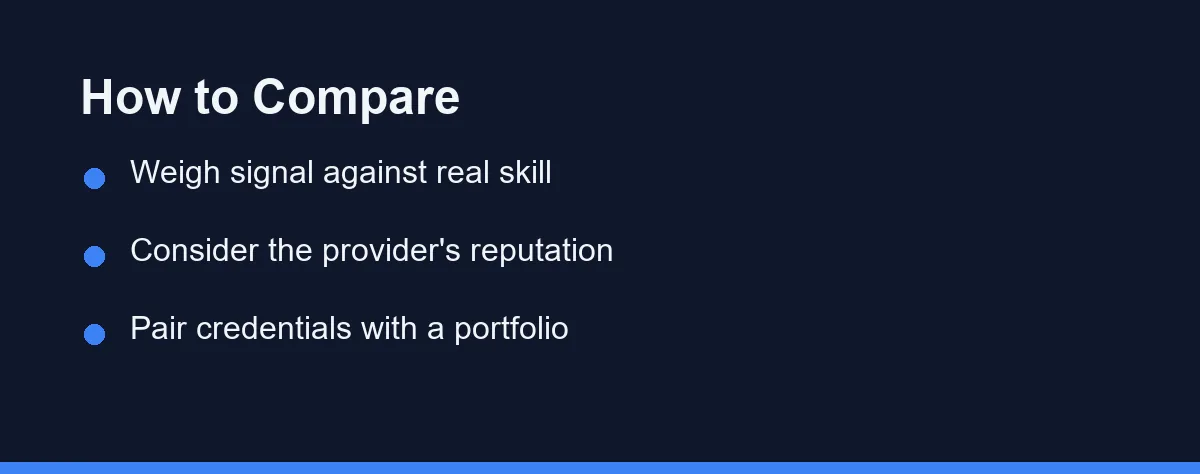
The pattern is clear on a scan. Recognized certificates add credibility, industry certifications add hiring power in specific fields, and skills-only courses add provable ability. None replaces demonstrated competence.
For a career switch, a recognized platform certificate plus a portfolio works well. For a technical role, an industry certification often leads. Matching the credential to the target role matters more than collecting badges.
The Portfolio Does the Talking
Judge whether a course teaches skills or just theory. Programs that require hands-on projects leave you with something to show, while passive video-watching with a quiz produces a weaker credential.
Plan your proof before you enroll. Decide how you will demonstrate the skill in a portfolio or in an interview story. The credential opens the conversation, and your work wins it.
Two finished projects with a clear problem, method, and result do more than a fifth certificate. Interviewers ask you to walk through your reasoning, which no completion page rehearses.
Skipping this step is the most common way credential-hunting turns into wasted effort. A stack of unrelated badges signals scattered attention rather than focus.
Read the Job Listing Before the Course Catalog

Begin with the role you actually want. Read several job postings and note the skills they demand most often. A certificate that maps directly to those skills carries real weight.
Prefer recognized platforms, universities, or industry bodies over unknown sources. The name behind the credential shapes how recruiters read it, and an obscure issuer weakens an otherwise solid effort.
Weigh the time and cost against the likely return. A short, affordable course that fills a specific skill gap is easy to justify, while an expensive program with vague outcomes deserves more scrutiny.
Our guide on whether Google career certificates are worth it works through that trade-off. The same test applies to longer programs in our guide on whether coding bootcamps are worth it.
What It Costs, and What You Are Buying
Online credential costs range from free to significant tuition. Individual courses and subscriptions sit at the lower end, while professional certifications and structured programs cost more. Confirm current pricing on each provider’s official site, as of 2026.
Many platforms let you audit courses free and pay only for the certificate. That structure keeps the learning affordable while the credential carries a fee. Subscriptions are the other common model, and as of October 2026 Coursera lists Coursera Plus at $59 a month or $399 a year. For budget-conscious learners, auditing plus selective certification works well.
Industry certifications usually carry exam fees and preparation costs. The higher price reflects their standardized, respected status. In fields that require them, the return can justify the spend.
Structured programs and bootcamps sit at the top of the range, bundling mentorship, projects, and support into the cost. Judge that price against the skill and evidence you gain, not the certificate alone.
Who Should Bother, and Who Should Not
How much a certificate helps depends almost entirely on who is reading your resume. Here is how the answer changes across five situations.
The career switcher with no relevant experience: A recognized certificate genuinely helps, because it gives a recruiter a reason to keep reading. Choose a named program such as a Google Career Certificate over an obscure provider. Then build projects from it, since the credential opens the file and the work wins the interview.
The experienced professional adding an adjacent skill: Your track record already carries the resume, so a certificate adds little on its own. What helps is a project at your current job that uses the new skill. Mention the credential in passing and lead with the outcome you produced.
The candidate targeting cloud, security, or networking roles: Vendor certifications from bodies like AWS, Cisco, or CompTIA outrank platform course certificates here. Many listings name them explicitly as requirements rather than preferences. Budget for the exam fee and study time, because these are tested credentials rather than completion badges.
The student still in a degree program: Treat certificates as internship preparation rather than resume filler. One course that teaches a tool your target internship lists is worth more than several general ones. Your degree is the credential, and the certificate is evidence you can apply it.
The freelancer or contractor selling services: Clients rarely check certificates and almost always check past work. Put your energy into a portfolio site and two detailed case studies. Use courses to close real skill gaps, not to decorate your profile.
Where Credential Hunting Goes Wrong
A few habits turn a reasonable plan into wasted months. Each is easy to avoid once named.
Do not treat a certificate as a guaranteed job, and do not collect badges with no plan. Employers hire for demonstrated skill, and unrelated credentials read as scattered effort.
Do not overpay for vague outcomes. An expensive program with no published results deserves scrutiny, so compare cost against concrete skills and job relevance first.
For career switchers and early-stage candidates, certificates genuinely help by signaling initiative. For the offer itself, demonstrated skill decides more than any badge. Match the learning to the job, choose recognized sources, and build a portfolio alongside it.
For related reading, see our guides on whether Google career certificates are worth it and coding bootcamps are worth it.
Two follow-ups decide how much a certificate actually returns. Presentation is the first: how to list an online course on your resume covers claiming the work without overselling it. Field choice is the second, and cloud credentials are where the signal is strongest right now, which AWS vs Azure cloud certification for beginners compares directly.
In IT support and security the sequence matters more than the certificate count, and CompTIA A+ vs Network+ vs Security+ covers which one to take first.
One question sits underneath all of this and rarely gets asked in time. If you also want academic credit rather than a hiring signal, do online courses count for college credit explains which routes reach a transcript.
AI credentials are the fastest-growing entry in this category, and they vary more than their names suggest. AWS AI Practitioner vs Azure AI Fundamentals vs Google Gen AI Leader sets out which of the three assumes coding knowledge and which assumes none.
Some subjects raise the question a step earlier, before any certificate is on the table at all. Self-study vs an online course for Python compares the free route with a paid one on how fast each reaches work a hiring manager can read.
FAQ
Do online course certificates help you get a job?
Online course certificates can help you get a job, but rarely on their own. They work best when paired with a portfolio, real projects, and skills you can demonstrate in an interview. Recruiters treat them as supporting evidence of initiative, not as a guaranteed qualification.
Which online certificates do employers actually respect?
Employers value certificates from recognized providers and industry leaders more than generic completion badges. A certificate backed by a known company or a rigorous assessment carries more weight. What matters most is whether it maps to skills the role actually requires.
Is a certificate or a portfolio more important for getting hired?
A certificate signals effort and foundational knowledge, while a portfolio proves you can do the work. For most hiring managers, demonstrated projects outweigh a certificate alone. The strongest candidates show both, a credential plus tangible results.
Where should you list an online certificate on a resume?
Put it in a dedicated certifications section near your education, and name the issuing organization rather than only the platform that hosted it. A line reading Google Data Analytics Certificate is recognized far more readily than one reading Coursera course completion. If the program ended in a capstone, add one bullet describing what you built and what it demonstrated. Recruiters scan for the skill, so that project detail does more work than the credential line alone.
How many online certificates should you take before applying for jobs?
One certificate matched to a specific target role usually beats three unrelated ones. A long list reads as scattered effort and invites the question of why you kept studying instead of applying. Finish one credential, build two or three projects from it, then start applying while you continue learning. Hiring depends on the interview and your demonstrated work, so time spent applying is rarely wasted.
Sources
- Coursera: Google IT Support Professional Certificate — checked 2026-10-15
- Coursera Plus: Plans and Pricing — checked 2026-10-15
Some links may be affiliate links. We may earn a commission at no extra cost to you.
How this article was made: it was drafted with AI assistance from the official sources listed above, and its figures were checked against those pages on the dates shown. It is not based on personal hands-on testing.
Comments
Post a Comment