Does Anyone Ever See Your Certification Exam Score

What Anyone Else Actually Sees
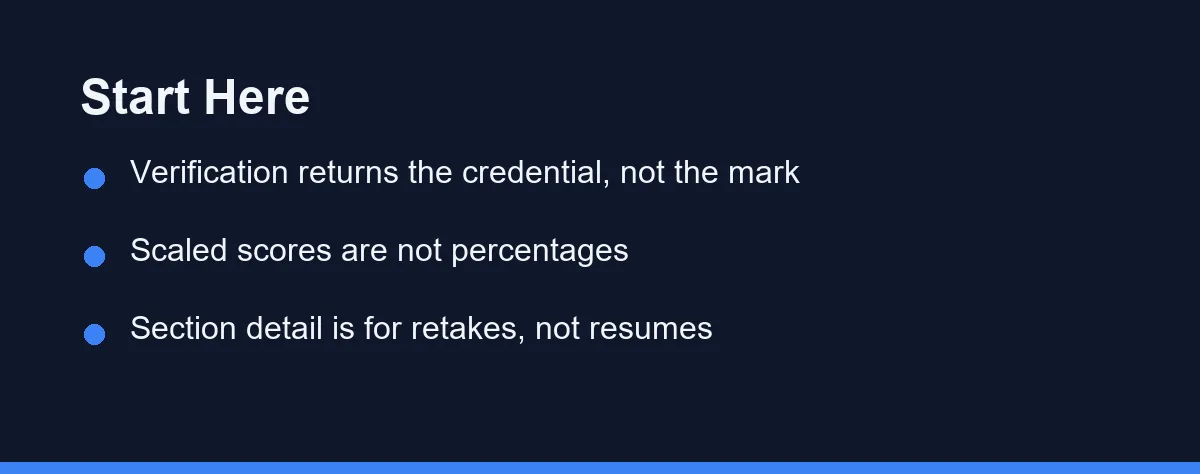
Nobody but you sees the number, because results carry a pass or fail designation and verification tools return the credential and its expiry rather than the mark. AWS Certified Cloud Practitioner passes at 700 on a 100 to 1000 scale, and Microsoft role based exams pass at 700 on a 1 to 1000 scale. CompTIA A+ Core 1 passes at 675 of 900, and Security+ at 750. If you cleared the bar by one point, you hold exactly the same credential as someone who cleared it by two hundred.
Scaled Scores Are Not Percentages
This is the single most misread part of a score report. Microsoft says it plainly: a passing score is 700 or greater, and because it is a scaled score it may not equal 70 percent of the points.
The scale exists because exam forms differ. Different candidates get different question sets, and some sets are simply harder than others.
Scaling corrects for that. For an easier set of questions more points are required to pass, and for a harder set fewer points are required, so the same scaled number represents the same level of knowledge either way.
The practical consequence is that you cannot reverse engineer how many questions you missed. People try constantly, and the arithmetic does not exist.
It also means a lower scaled score on a retake is not automatically worse performance. If your second form was easier, the same knowledge converts into a different number, and the comparison people most want to make is the one the scale is designed to prevent.
The useful comparison is against the bar, not against your previous attempt. Passing by 40 points on a hard form and by 90 on an easy one are the same outcome.
The Passing Marks on Four Common Exams
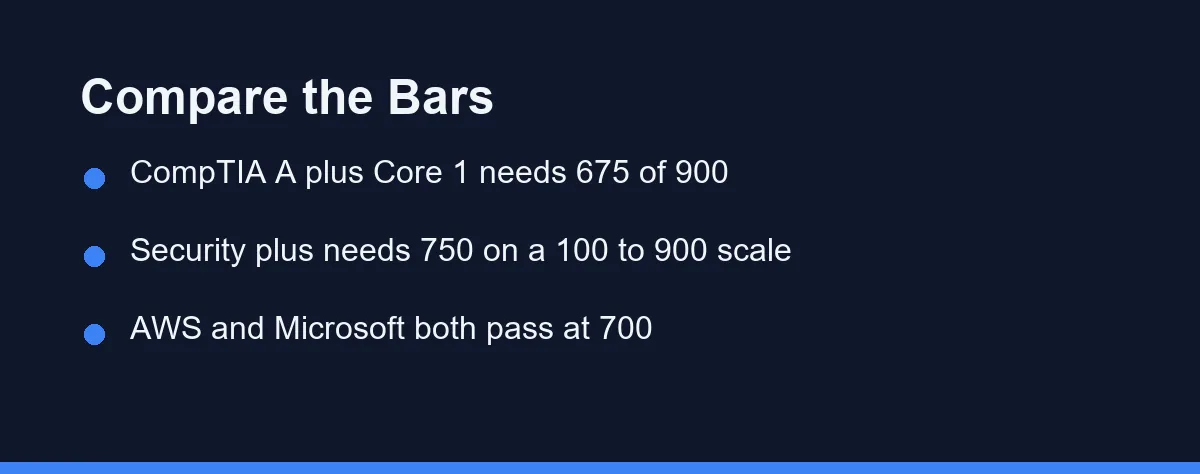
The bars sit in different places, which is another reason comparing your number to a friend is meaningless.
| Exam | Score scale | Passing mark | Format | What the report adds |
|---|---|---|---|---|
| CompTIA A+ Core 1, 220-1201 | Up to 900 | 675 | Max 90 questions in 90 minutes | Weakest objective areas |
| CompTIA A+ Core 2, 220-1202 | Up to 900 | 700 | Max 90 questions in 90 minutes | Weakest objective areas |
| CompTIA Security+, SY0-701 | 100 to 900 | 750 | Max 90 questions in 90 minutes | Weakest objective areas |
| AWS Certified Cloud Practitioner, CLF-C02 | 100 to 1000 | 700 | Includes 15 unscored questions | Section level performance |
| Microsoft role based exams | 1 to 1000 | 700 | Varies by exam | Section level performance |
Notice that the two halves of a single certification do not even share a bar. A+ Core 1 passes at 675 and Core 2 at 700, both on a 900 point scale, because they were standard set separately.
Why a 700 Means Different Things on Different Exams
A 700 on the AWS foundational exam sits comfortably above its bar of 700 only in the sense that it is exactly the bar. The same 700 on Microsoft is also exactly the bar. On CompTIA A+ Core 1 the number 700 would be a pass with room to spare.
None of these numbers are interchangeable, and none of them are grades in the school sense. They are the output of a standard setting process where subject matter experts decide what minimum competence looks like for that specific role.
That process is the reason the bar can move between exam versions. When a new version launches, the standard is set again against the new objectives, so comparing your Security+ number to someone who sat an older version tells you nothing.
How the Bar Gets Set in the First Place
Nobody picks a passing mark by rounding. AWS describes its exams as scored against a minimum proficiency standard established by AWS professionals following certification industry practice, and CompTIA and Microsoft run comparable processes.
The work happens before anyone sits the exam. Subject matter experts review each question and judge how a minimally competent practitioner would perform on it, and those judgments aggregate into the cut score.
That is why the bar lands on odd numbers like 675 and 750 rather than round ones. The number is an output of the process rather than a target chosen for tidiness.
It also explains why the bar is defended rather than negotiated. Certification bodies cannot lower it for a difficult cohort without breaking the promise the credential makes to employers, which is the promise that a holder met a defined standard.
Where the 15 Unscored Questions Fit
AWS includes 15 unscored questions on the Cloud Practitioner exam, and they do not affect your score at all. They are there so AWS can evaluate new questions before those questions count for anyone.
You cannot identify them while sitting the exam, which is the point. Answer everything with the same care and the unscored items take care of themselves.
Most large certification programs do something similar. It is another reason the question count on the exam guide and the number of questions that decide your fate are not the same figure.
What the Score Report Is Genuinely Useful For
The report earns its keep in exactly one situation, which is planning a retake.
CompTIA returns your weakest objective domains. AWS and Microsoft return section level performance. Neither gives you per question detail, and neither is precise enough to argue with, but both point you at the two or three topics that cost you the attempt.
Read that list the same day you sit the exam, while the questions are still fresh. Write down which specific topics inside those domains felt uncertain, because the report names the domain and only your memory names the topic.
Then rebuild the study plan around those areas rather than starting the whole syllabus again. Our notes on how long to study for an IT certification assume a first attempt, and a targeted retake is usually a much shorter project.
If the report arrived with a fail, our guide on what to do after failing a certification exam covers the retake timing and the fee side.
Where Section Scores Mislead You
A weak section on a passing exam looks alarming and often is not. AWS uses a compensatory scoring model, which means you do not need to reach a passing standard in each section and only need to pass overall.
That design is deliberate. Real roles allow strength in one area to offset thinness in another, and the exam models that.
The trap is treating a low section as proof of failure to learn. It might be, or it might reflect a section with only a handful of questions where one unlucky item moved the bar a long way.
The reverse trap is more expensive. A comfortable overall pass can hide a genuinely empty section, and that gap tends to surface in a technical interview rather than on the exam.
There is also a sample size problem nobody mentions. A domain weighted at 10 percent of a 90 question exam is being measured with roughly nine questions, which is not enough to separate a small gap from an unlucky afternoon.
So treat section detail as a hint rather than a diagnosis. If two attempts flag the same domain, believe it. If one attempt flags a domain you can explain confidently at a whiteboard, let it go.
Which Reading of Your Score Fits Your Next Move
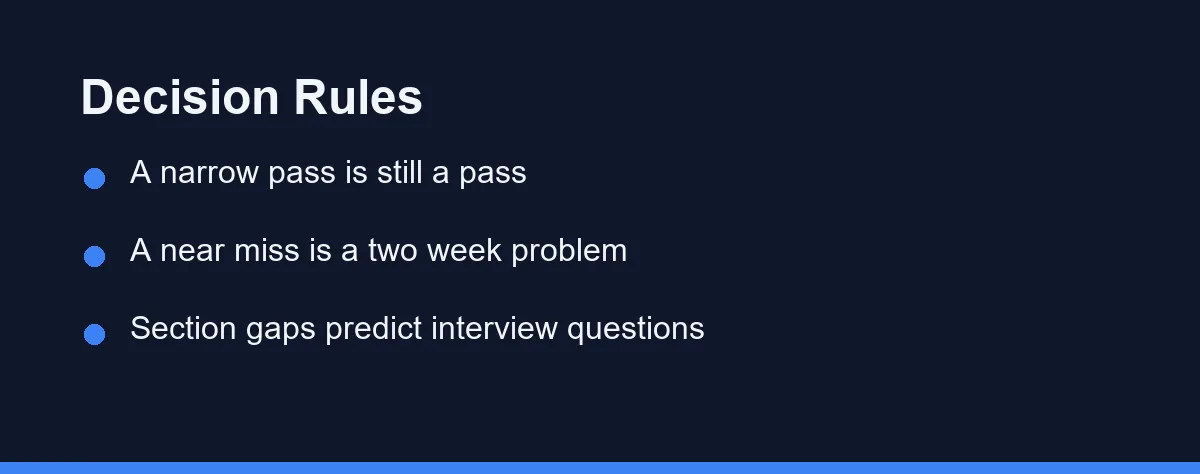
You passed narrowly and feel like a fraud. You hold the credential and it is identical to everyone else who holds it. Spend the energy on a project that uses the knowledge, since do employers verify online certificates covers what actually gets checked.
You failed within about 30 points of the bar. Treat this as a two week problem rather than a restart. The weak domains named on your report are almost certainly the whole gap, and the exam content did not change between attempts.
You failed by a wide margin. The study method is the issue, not the revision. Wide misses usually mean passive study, so shift toward practice questions and hands on work before booking again.
You passed but one section was clearly hollow. Fix it anyway, on your own schedule. Nobody will see the section score, but an interviewer will ask about that exact area, and a certification you cannot talk through is worth very little.
You are choosing which exam to sit first. Bar heights should not drive that decision, because they are not comparable across programs. Sequence matters far more, which is the subject of CompTIA A plus versus Network plus versus Security plus.
What Belongs on the Resume Instead
List the certification, the issuing body and the date. That is the complete convention, and adding a score reads as inexperience rather than strength.
If the number genuinely felt like an achievement, convert it into something a reader can use. A short line about the lab you built or the migration you scripted carries far more weight than any three digit figure.
The full formatting question is covered in how to list an online course on your resume, and the same rules apply to certifications.
The Number That Expires the Day You Pass
Your scaled score has a working life of about a week. Before the exam it is a source of anxiety, immediately after it is a study map for a retake, and after that it is trivia.
The credential is what persists, along with whatever you can demonstrate. Passing marks and score scales also change with exam versions, so confirm the current figures on the official exam page before planning around any specific number.
If you are still deciding whether the whole exercise pays off, the honest version of that answer is in do online certificates help get a job.
If the score is mainly useful as a study map, the map itself is published long before you sit. Our walkthrough of how to read a certification exam blueprint covers the domain weights that decide where your hours belong.
FAQ
Can an employer look up my certification exam score?
Almost never. Verification systems confirm that a credential is valid and current, and the numeric score is not part of what they return. A hiring manager checking your CompTIA or AWS credential sees the certification and its expiry, not the mark.
Is a scaled score the same as a percentage correct?
No. A scaled score adjusts for how hard your particular question set was, so 700 out of 1000 does not mean you answered 70 percent correctly. Microsoft states this directly, and it is the reason two people with identical raw answers can see different scaled numbers.
Do I have to pass every section of the exam?
Not for the outcome. AWS uses a compensatory model, meaning you only need to pass the exam overall rather than every section. Weak sections still matter for what you actually know, but they do not fail you on their own.
What is the score report actually good for?
Use it as a study map rather than a grade. CompTIA reports which objective areas you were weakest in, and AWS reports section level performance, both of which tell you where to spend the next two weeks before a retake.
Should I put my exam score on my resume?
Only to you. Once you hold the credential, the passing mark and the top mark are the same credential, and no resume convention exists for listing an exam score. Space on a resume is better spent on what you built with the knowledge.
Sources
- AWS Certified Cloud Practitioner (CLF-C02) exam guide — checked 2026-10-15
- Microsoft Learn: Exam scoring and score reports — checked 2026-10-15
Some links may be affiliate links. We may earn a commission at no extra cost to you.
How this article was made: it was drafted with AI assistance from the official sources listed above, and its figures were checked against those pages on the dates shown. It is not based on personal hands-on testing.
Comments
Post a Comment