Microsoft or CompTIA Certification for a First Help Desk Job?

Two Different Bets on the Same Job
The short answer: take CompTIA A+ if you have no support history and no specific employer in mind. Take a Microsoft fundamentals exam such as AB-900 when the job ads in your area name Microsoft 365, Intune, or Azure.
Almost every guide to breaking into IT points at the same two doors. One is CompTIA A+, the vendor-neutral classic. The other is a Microsoft fundamentals exam such as AB-900 or AZ-900. Microsoft retired the older MS-900 exam on March 31, 2026, so guides that still recommend it are out of date.
They cost roughly the same order of money and take a similar slice of your evenings. They also send very different signals to the person reading your resume.
The choice is not really about which exam is harder. It is about whether you know where you will work.
A candidate who knows the target employer runs Microsoft 365 should study that stack. A candidate applying anywhere that will take them needs the broader ground first.
The Short Answer for a First Help Desk Role
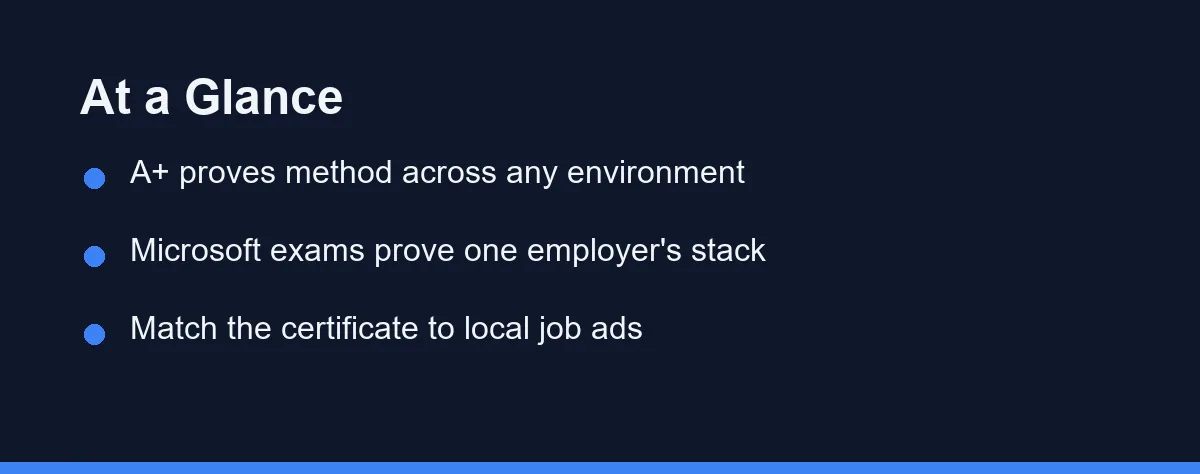
Take CompTIA A+ when you have no support history and no specific employer in mind. It teaches a troubleshooting method that transfers across hardware, operating systems, and small networks.
Take a Microsoft fundamentals exam when the job ads in your area name Microsoft 365, Intune, or Azure. In that case the vendor credential speaks directly to the tools you would touch on day one.
Either path works. The failure mode is collecting both halfway and finishing neither, which happens more often than any exam result.
What Help Desk Job Postings Actually Ask For
Read twenty entry-level support ads in your own city before buying any course. The pattern in your local market matters more than any national ranking of certifications.
Most postings list a credential as preferred rather than required. That word does real work, because it means a candidate with adjacent experience can still be shortlisted without it.
Look for what sits in the responsibilities section instead. Phrases such as password resets in Active Directory, Intune enrolment, or ticket triage in a named system tell you which stack the team actually runs.
If those phrases skew heavily Microsoft, the vendor exam is the sharper tool. If the ads describe imaging laptops, replacing hardware, and supporting a mixed fleet, A+ maps better to the daily work.
How the Two Certification Families Are Built
CompTIA builds vendor-neutral exams around job roles. A+ covers hardware, operating systems, mobile devices, security basics, and a structured troubleshooting process, split across two exams you take separately.
Network+ and Security+ sit above it as the natural second and third steps. Our breakdown of which CompTIA exam to take first walks through that sequence in more detail.
Microsoft organises its catalogue by product and role. Fundamentals exams such as AB-900, AZ-900, and SC-900 give a single-day overview of one product family, while role-based exams such as MD-102 go deeper into administration.
The two families answer different questions. CompTIA asks whether you can diagnose a problem you have never seen, and Microsoft asks whether you know a specific console.
The Certifications Side by Side

The table groups the credentials that realistically appear in entry-level support hiring, as of 2026. Exam fees, bundles, and renewal terms change, so confirm current details on the issuer’s own site before you pay.
| Certification | Issuer | Best suited to | Renewal model | What a hiring manager reads into it |
|---|---|---|---|---|
| A+ | CompTIA | First support role with no known stack | Three-year cycle with continuing education | Broad ground-level competence |
| Network+ | CompTIA | Second step once tickets involve connectivity | Three-year cycle with continuing education | You can read a network diagram |
| Security+ | CompTIA | Roles touching compliance or public sector work | Three-year cycle with continuing education | Baseline security literacy |
| AB-900 | Microsoft | Teams running Microsoft 365 day to day | Fundamentals level does not expire | You know the tenant you would support |
| AZ-900 | Microsoft | Employers moving workloads to Azure | Fundamentals level does not expire | Cloud vocabulary without depth |
| MD-102 | Microsoft | Device and endpoint management duties | Free annual renewal assessment | You could manage an enrolled fleet |
| IT Support Certificate | Google, via Coursera | Complete beginners with no technical background | No renewal requirement | You finished something structured |
Two things stand out in that grid. The CompTIA line demands ongoing effort every three years, and the Microsoft fundamentals line asks nothing after you pass.
That difference rarely changes a first decision, though it shapes the second one. Renewal obligations stack up quietly once you hold three or four credentials, and our guide to renewal versus retaking the exam covers how that plays out.
Where Each One Falls Short
A+ has a reputation problem among people already working in IT. Some engineers dismiss it as basic, and that dismissal is fair for anyone with two years of hands-on support behind them.
For a career changer, that criticism misses the point. The value sits in the vocabulary and the diagnostic order, not in the difficulty of the questions.
Microsoft fundamentals exams have the opposite weakness. They are narrow enough that passing one proves familiarity with a product tour rather than an ability to fix anything.
Neither credential closes the real gap. Support work is judged on how you handle a frustrated user and an unclear problem, and no multiple-choice exam measures that.
Which Certification Fits Your Situation
- ● Unknown employer stack favours A+
- ● Known Microsoft shop favours AB-900
- ● One finished cert beats three started
Career changer with no IT background: Start with A+. The two-exam structure forces breadth, and it gives you the shared language that every later credential assumes you already have.
Someone applying to a known Microsoft 365 shop: AB-900 first, then A+ if the role stays broad. Naming the tenant your interviewer supports is worth more than a general credential they see on every resume.
Internal candidate moving from another department: Skip the beginner tier and take the exam that matches the team you want to join. Your colleagues already know you can work there, so the credential only has to prove technical intent.
Recent graduate with a computing degree: A+ may be redundant. Look at Network+ or a Microsoft role-based exam instead, since the degree already covers what A+ certifies.
Someone targeting government or defence contractors: Security+ appears in those requirements far more often than either alternative. Check the specific contract language before choosing anything else.
Anyone on a hard budget: The Google IT Support Certificate costs less per month and includes structured practice. Treat it as preparation rather than a destination, as covered in our look at whether online certificates help you get hired.
Someone who already failed one exam: Return to the same one rather than switching families. A near miss means the material almost landed, and a fresh syllabus resets that progress to zero.
The Third Option Nobody Mentions
Both certifications answer the same underlying question: how do you prove capability without a support history? A credential is one answer, and it is not the only one.
Internal transfers beat external applications by a wide margin in support hiring. Anyone already working at a company with an IT team can ask to shadow it, take overflow tickets, or cover holiday absence.
Managed service providers hire at volume and train on the job. The work is demanding and the turnover is high, and it remains one of the fastest routes into paid support experience for someone with no background.
Apprenticeships and government-funded schemes exist in many countries and go badly underused. They pay while you learn, which no certification path does.
None of these replace a credential permanently. They change its role from an entry ticket to a formality you complete while already employed, which is a much easier version of the problem.
What the Whole Thing Costs Beyond the Exam
Exam fees are the visible number and rarely the largest one. Study materials, practice tests, and a retake voucher often add up to more than the sitting itself.
Time is the heavier cost. Several weeks of evening study has a real price for anyone working full time, and that price does not appear in any comparison chart.
Employer support changes the arithmetic completely. Many IT departments reimburse a first certification, and some pay for the retake, so ask before spending your own money.
Our breakdown of the real cost of an IT certification itemises the pieces people forget. Read it before committing to a two-exam path.
A Study Order That Does Not Waste Months
Pick one exam and set a sitting date before you open a single video. An unbooked exam drifts, and drifting is the main reason people abandon a certification they had almost finished.
Work through the official objectives list as a checklist rather than a syllabus to read once. Every question on the exam maps to a line in that document, which makes it the most efficient study map available.
Add practice tests early rather than at the end. Their real value is showing you which objectives you have quietly skipped, and that signal is worthless the week before the exam.
Build something small alongside the reading. A spare laptop or a virtual machine turns abstract terms into things you have clicked.
The Part That Actually Gets the Interview
A certificate opens a filter, and a story gets the offer. Hiring managers for support roles ask how you handled a difficult user long before they ask about exam objectives.
Prepare two concrete examples: a problem you diagnosed step by step, and a moment you explained something technical to someone frustrated. Both can come from outside IT.
Put the credential in a position that supports that story. Our guide to listing an online course on your resume shows where it belongs and how to describe it without overstating.
The honest summary is that A+ and a Microsoft fundamentals exam both work, and the local job market decides which works better. Choose the one your target employers name, finish it, then let the interview do the rest.
If the target role is networking rather than general support, the comparison shifts toward Cisco. Our guide to choosing between the CCNA and Network Plus uses local job ads to decide which exam to book first.
FAQ
Should I take CompTIA A+ or a Microsoft certification first?
For a generalist help desk role, A+ is the safer first choice because it covers hardware, operating systems, and troubleshooting method rather than one vendor's stack. Choose a Microsoft fundamentals exam first only when you already know the employer runs on Microsoft 365 or Azure.
Do you need a certification at all for an entry-level help desk job?
No. Help desk postings usually name one or two certifications as preferred rather than required, and many accept equivalent experience. The certificate mainly helps a resume survive the first filter when you have no support history to point at.
Is it worth holding both A+ and a Microsoft fundamentals certification?
Both count as entry-level credentials, so stacking them adds less than people expect. A stronger pairing is one broad certification plus a demonstrable skill, such as a ticketing system you have used or a home lab you can describe.
How long do these certifications stay valid?
CompTIA certifications run on a three-year cycle with continuing education credits, while Microsoft fundamentals credentials do not expire and role-based ones use a free annual renewal assessment. Confirm the current rules on each issuer's site before you plan a budget.
How long does it take to prepare for a first IT certification?
Study time varies with background, but most candidates report several weeks to a few months of evening study for a first exam. Microsoft fundamentals exams are narrower and generally take less preparation than the two-exam A+ series.
Sources
- Microsoft Learn: Study guide for Exam MS-900 (retirement notice) — checked 2026-10-15
- Microsoft 365 Certified: Copilot and Agent Administration Fundamentals (AB-900) — checked 2026-10-15
- Microsoft Learn: Credential expiration policies — checked 2026-10-15
Some links may be affiliate links. We may earn a commission at no extra cost to you.
How this article was made: it was drafted with AI assistance from the official sources listed above, and its figures were checked against those pages on the dates shown. It is not based on personal hands-on testing.
Comments
Post a Comment