Associate Degree vs Certificate for Tech Jobs: Which First?
Two Years or Twelve Weeks
For most first-time IT support applicants, a certificate is the faster start, and an associate degree suits network roles or a later bachelor’s. The Bureau of Labor Statistics says computer user support specialists may qualify with a high school diploma plus IT certifications. Network support specialists, by contrast, typically need an associate’s degree. The same BLS page puts the 2025 median pay for computer support specialists at $62,890 a year.
The tension is easy to feel. A degree signals breadth and staying power, while a certificate signals a specific, current skill. Employers weigh them differently depending on the role and the company.
There is also a money and time dimension. An associate degree stretches across roughly two years and higher tuition. A certificate often wraps up in months at a fraction of the cost. That gap changes the risk you take on.
The degree does carry a measurable edge in national data. In BLS figures for 2024, full-time workers aged 25 and over whose highest credential was an associate’s degree had median weekly earnings of $1,099. Workers with some college but no degree had $1,020. Unemployment was 2.8% for the associate’s group and 3.8% for the some-college group.
Fast Into One Role, or Broad and Transferable
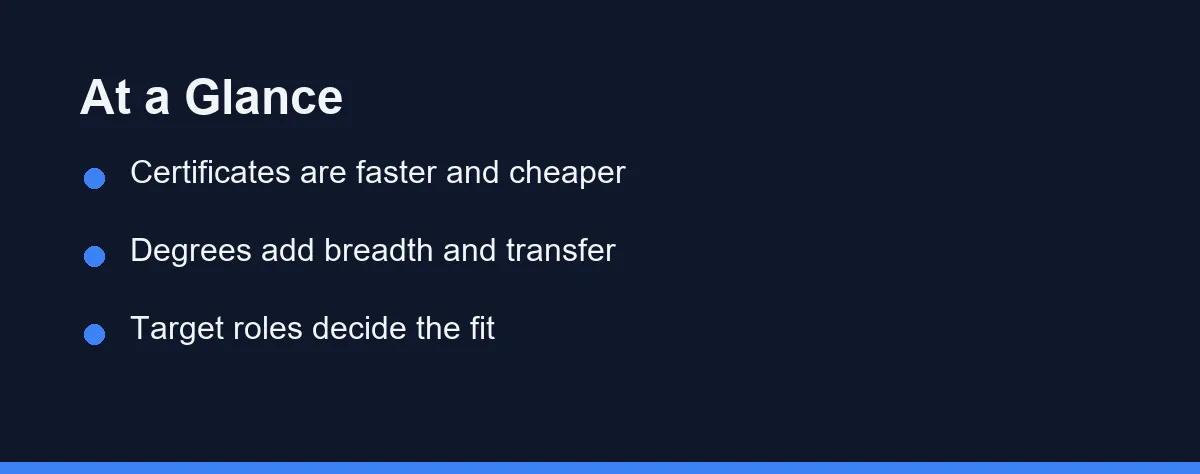
Pick a certificate if you want a fast, low-cost route into a specific entry role and can back it with projects. Pick an associate degree if you value broader coverage, want credits that may transfer, or target employers that list a degree. The two differ most in time, cost, and transfer value.
A certificate concentrates on one skill area, such as IT support or cloud fundamentals. You can often finish in a few months and start applying with a portfolio. That speed suits a quick pivot on a tight budget.
An associate degree spans about two years and adds general education alongside your major. It costs more, but many programs transfer credits toward a bachelor’s later. That path suits learners planning a longer academic climb.
Neither is universally better. A certificate wins on speed and price, while a degree wins on breadth and transfer. Our guide on do online certificates help get a job unpacks how hiring managers actually read these credentials.
Read a Dozen Postings for the Role You Want
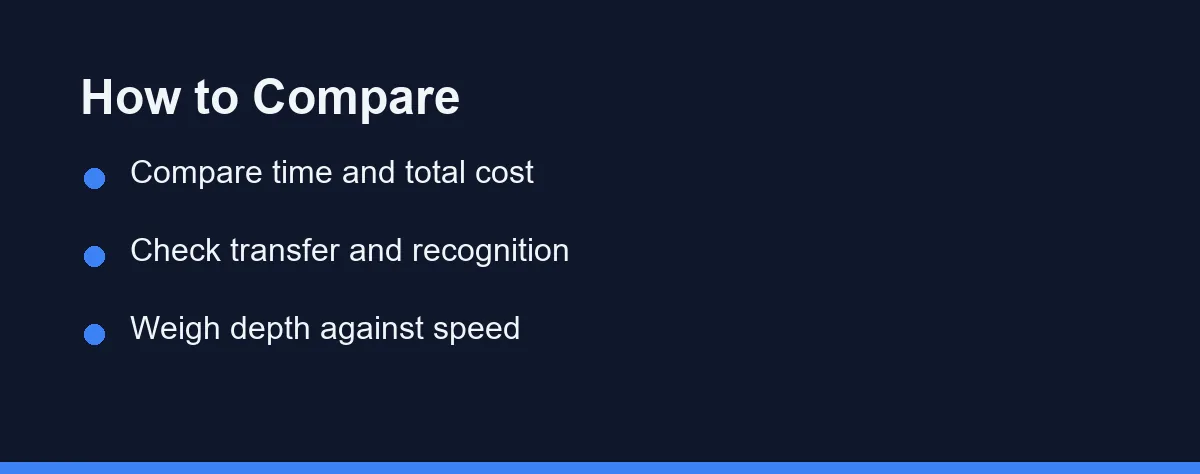
Begin with the roles you actually want. Read a dozen real job postings and note which credentials they request. That single habit grounds the decision in evidence instead of guesswork.
Weigh your available time honestly. A certificate fits months, while a degree asks for years of steady effort. Choosing a timeline you cannot sustain wastes both money and momentum.
Check the transfer value of each option. Associate degree credits often count toward a bachelor’s, while certificates usually do not. If a four-year degree may follow, that difference matters a great deal.
Consider the depth you need for the work. Support and help-desk roles reward focused, current skills, while some technical tracks reward broader foundations. Match the credential’s depth to the job’s demands.
Finally, look at what you can show afterward. A credential opens a door, but projects and a portfolio often decide the interview. Our comparison of are Google career certificates worth it shows how one popular certificate performs in practice.
Comparing the Two Routes
The choice becomes clearer once you see how each credential is built. Their designs pull in different directions.
The Certificate Route
Certificates target one skill cluster and skip general education entirely. Well-known examples include the Google Career Certificates, CompTIA A+, and vendor programs from AWS or Microsoft. You finish a focused curriculum, often online and self-paced.
This route suits people who need to start earning soon. The short timeline and lower cost reduce the risk of testing a new direction. Pairing the certificate with hands-on projects strengthens a thin resume quickly.
The limit is scope. A single certificate proves one competency, not a broad foundation. For roles that expect wider knowledge, you may need several certificates or later study to fill the gaps.
The Associate Degree Route
An associate degree, often from a community college or a school like WGU, blends a technical major with general courses. You study your field alongside writing, math, and electives across about two years. The result is a recognized academic credential.
This route suits learners who want breadth and a possible bridge to a bachelor’s. Many programs hold articulation agreements that transfer credits to four-year schools. That option can save money on a later degree.
The cost is time and tuition. Two years is a long runway when you need income sooner. The general education requirements also slow your path to the specific skill an employer wants. Our look at are coding bootcamps worth it offers a third route to weigh against both.
The Two Credentials in a First Job Search
The table below sets the two credentials side by side on the factors that shape a first job search. Read it as a guide, not a verdict. Your target roles still lead.
| Factor | Certificate | Associate Degree |
|---|---|---|
| Typical time | A few months | About two years |
| Relative cost | Lower | Higher |
| Scope | One focused skill | Major plus general education |
| Transfer value | Rarely transfers | Often transfers to bachelor’s |
| Recognition | Strong for entry roles | Broad, formal recognition |
| Best portfolio pairing | Projects and labs | Projects and coursework |
| Best fit | Fast, focused entry | Breadth and future study |
Reading down the columns, the trade-off stands out. A certificate trades breadth for speed and price, while a degree trades time and cost for scope and transfer. Each answers a different question about your plan.
If you need to start applying within months, the certificate route moves fastest. If you want a foundation that may bridge to a bachelor’s, the degree route holds more. Your timeline and long-term aim decide.
Tuition Against Program Fees
Costs vary widely by school, provider, and location, so treat every figure here as a rough guide. Certificates generally cost far less than an associate degree, though the exact totals shift constantly. Confirm current pricing on the official site of each program, at the time of writing.
Many tech certificates fall in the low hundreds of dollars, and some subscription-based ones spread payments across months. Financial aid and scholarships sometimes apply, but the headline cost stays modest. That low outlay is part of the appeal for a quick pivot.
An associate degree typically runs into the thousands across two years, even at an affordable community college. Tuition, fees, and materials add up, though aid can offset a share. The higher total buys breadth and transferable credit.
Weighing the two, estimate not just tuition but the income you delay while studying. A short certificate gets you applying sooner, while a degree asks for a longer investment. Confirm all current costs and aid options on the official sites, at the time of writing.
Choosing a Credential Before Reading Postings
A handful of errors lead learners to overspend or aim wrong. Most are simple to sidestep.
Do not choose a credential before reading real job postings. The listings for your target roles reveal what employers actually request. Skipping that step risks studying for a qualification no one asks for.
Do not assume a certificate transfers as academic credit. Most do not, so a later degree may start from scratch. If a bachelor’s is likely, the associate path protects those credits.
Do not lean on the credential alone. A degree or certificate opens a door, but projects usually win the interview. Build a portfolio while you study, not after.
Do not ignore the income you postpone. Two years of study delays earning far more than a few months. Factor that lost time into the true cost of a degree.
Which Route Fits Your Timeline
Career changer who needs to start earning within months: A certificate fits, since its short timeline gets you applying while savings last. Pair it with two or three real projects to offset a thin resume. Focus on a role that hires for demonstrated skill, like IT support.
Learner planning to reach a bachelor’s degree eventually: An associate degree suits you, because its transferable credits shorten the later four-year path. The general education requirements double as early degree progress. Confirm articulation agreements with your target university before enrolling.
Budget-first learner testing whether tech is the right field: Start with a certificate, since its low cost limits the loss if you change direction. You gain a current skill and a clearer sense of the work. If interest holds, a degree can follow with less doubt.
Applicant targeting employers with formal degree filters: An associate degree carries more weight where HR systems screen for credentials. Some larger firms list a degree as a baseline. Research the specific companies you want, since policies differ sharply between them.
Undecided learner unsure which tech niche fits: A certificate lets you sample one area at low risk before committing years. You learn what the daily work feels like. Once a niche clicks, a degree or a second certificate can deepen it.
Different Plans, Different Timelines
An associate degree and a tech certificate both open doors, but they suit different plans and timelines. The certificate rewards a fast, focused, low-cost entry backed by projects. The degree rewards breadth, formal recognition, and credits that may transfer later.
Lean toward a certificate if you need to start soon, want to limit spending, or are testing a direction. Lean toward an associate degree if you value broad coverage, target degree-filtering employers, or plan a bachelor’s. Neither is right for everyone.
Before enrolling, read the postings for your target roles and total the real cost, including delayed income. A credential that matches those jobs beats one chosen on reputation alone. Evidence should guide the first step.
Revisit the choice as your goals mature. A certificate that starts a career may lead into a degree down the road. For more, see our guides on do online certificates help get a job and are Google career certificates worth it.
There is a third path that sits between the two, which is earning credit outside a classroom. Our guide to whether online courses count for college credit covers the routes that a registrar will actually record.
The same argument returns later at graduate level, with much larger numbers. Our comparison of an online master’s degree against stacked certificates sets the published costs side by side.
FAQ
How long does an associate degree take compared with a tech certificate?
An associate degree usually takes about two years of part-time or full-time study, while many tech certificates can be finished in a few months. The degree covers general education alongside your major, which stretches the timeline. A certificate strips away that breadth to focus on one skill set. Your available time should steer the choice as much as the outcome.
Do employers prefer an associate degree or a certificate for tech jobs?
Some employers list an associate degree as a preferred qualification, especially larger firms with formal HR filters. Many others accept a strong certificate plus a portfolio, particularly for entry roles in support, cloud, or web work. Neither guarantees an interview on its own. What you can demonstrate often outweighs the credential type.
Is a certificate cheaper than an associate degree for entering tech?
A certificate is generally cheaper and faster, so it carries less financial risk if you are testing a career direction. An associate degree costs more but may transfer toward a bachelor's later. If you are unsure about committing years and tuition, starting with a certificate keeps your options open. Confirm transfer rules with the specific school.
Can an associate degree count toward a bachelor's degree later?
Yes, credits from many associate degrees can transfer toward a bachelor's degree, though the amount varies widely by school and program. Certificates rarely transfer as academic credit, since they are not accredited coursework in most cases. If a four-year degree is a likely next step, the associate path protects that option. Check each institution's articulation agreements first.
Is an associate degree or certificate enough to get a first tech job?
For a fast, focused entry into a support or cloud role, a well-known certificate plus projects can be enough to start applying. For roles that list a degree or for a longer academic plan, an associate degree carries more weight. Match the credential to the specific jobs you want, not to general advice.
Sources
- BLS Occupational Outlook Handbook: Computer Support Specialists — checked 2026-10-15
- BLS Career Outlook: Education pays, 2024 — checked 2026-10-15
Some links may be affiliate links. We may earn a commission at no extra cost to you.
How this article was made: it was drafted with AI assistance from the official sources listed above, and its figures were checked against those pages on the dates shown. It is not based on personal hands-on testing.
Comments
Post a Comment