How to Check if an Online Certificate Is Legitimate

The Word That Does the Most Work in Course Marketing
The short answer: check who issues the credential, whether the accreditor appears in an independent recognition directory, and whether a public verification page exists. Those three checks resolve most cases in under ten minutes, and the sales page is the one place you cannot do them.
Course pages rarely lie outright. They lean on words that sound like guarantees and mean almost nothing, and “accredited” is the hardest working of them.
A page can say accredited while referring to a body that exists only as a logo. It can say certified while meaning that the instructor holds a certificate from somewhere else entirely.
None of that is detectable from the sales page, because the sales page is where the ambiguity is manufactured. The check has to happen somewhere the seller does not control.
The good news is that verification is quick once you know which three things to look at. Most of the credentials people worry about resolve in under ten minutes.
The Short Version
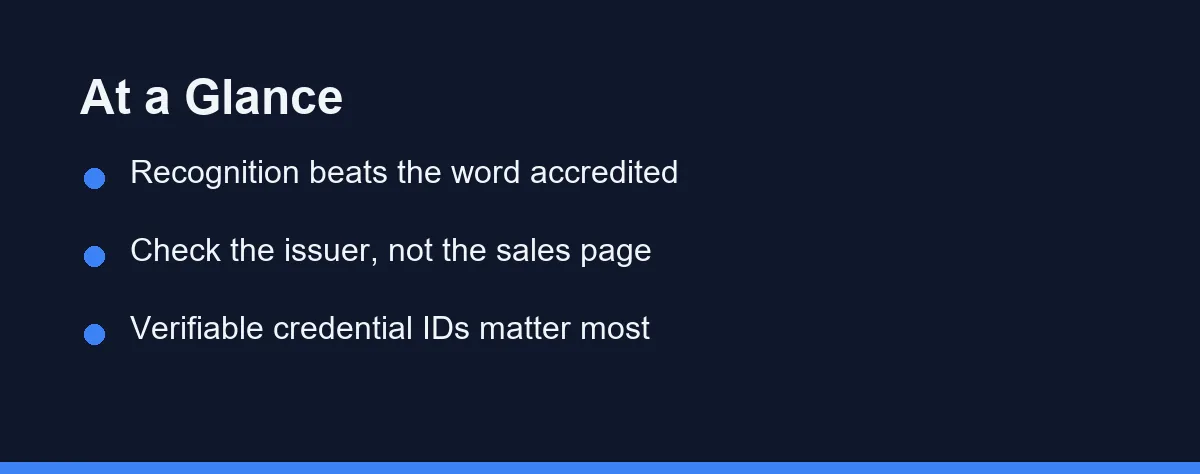
Ask who issues the credential, whether anyone outside the seller recognises it, and whether a third party can confirm you hold it. Those three answers decide almost everything.
Recognition matters more than the word accredited for most technology and creative skills. A credential hiring managers name in job postings is worth more than an accreditation nobody checks.
Accreditation matters enormously in the narrow set of fields where a licence, a regulator, or a university admissions office is involved. In those cases it is the only thing that matters.
Three Different Things, One Confusing Word
A completion certificate confirms you finished something. The platform records that you watched the material and passed the assignments, and the value comes entirely from whether anyone respects that platform.
A vendor or professional certification confirms you passed an exam against published objectives. These usually come with a credential ID, an expiry date, and a public page where anyone can confirm the record.
Institutional accreditation is a status held by a school or programme, granted by a body that reviews it against published standards. It applies to the institution, not to the individual course you are considering.
The three get blurred deliberately in marketing copy. A short course marketed with the vocabulary of accreditation is the most common shape of the problem, and it usually falls apart on the first independent search.
Eight Checks Before You Pay
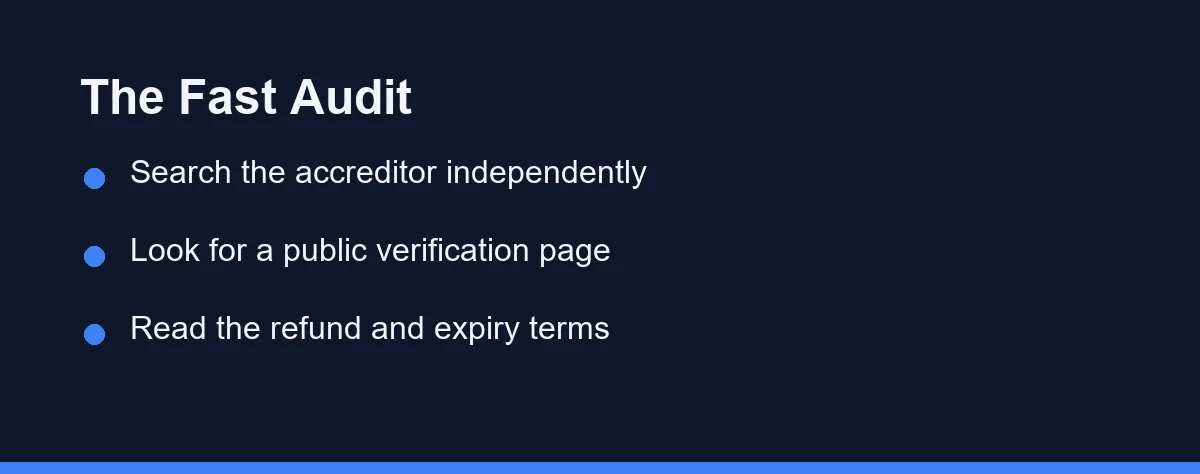
Work down the list until something fails. In practice, the accreditor search and the verification page resolve most cases before you reach the bottom.
| Check | What a legitimate credential shows | Warning pattern | Where to look |
|---|---|---|---|
| Who issues it | A named institution, vendor, or professional body | Only a platform name, or a brand with no legal entity | Course page footer and terms |
| The accreditor | A body you can find in an independent recognition directory | An accreditor that exists only on the school’s own site | National or regional recognition lists |
| Verification record | A public page where a credential ID can be confirmed | No way for anyone to check the credential exists | Issuer’s verification portal |
| Assessment method | A proctored exam or graded work against stated objectives | Certificate on completion of video watching alone | Syllabus and exam policy |
| Expiry and renewal | Clear validity period and renewal requirements | Permanent validity claimed for a fast-moving field | Certification policy page |
| Employer language | The exact credential name appears in real job postings | Only the seller uses the phrase | Job boards, in your target market |
| Refund and cancellation terms | Written policy with a stated window | Pressure pricing and countdown timers | Terms and conditions |
| Contact and legal details | A registered address and a working support channel | Contact form only, no entity, no address | Site footer and legal pages |
The employer language row is the most underrated check on the list. If a credential is worth having, the people hiring for it will already be using its name, and job postings are a free and current source of that signal.
How to Search for an Accreditor Properly
Search for the accrediting body by name on its own, without the school attached. A recognised accreditor has a public site, published standards, and a searchable list of the institutions it accredits.
Then reverse the check. Find the accreditor’s own directory and look for the school inside it, rather than trusting the claim on the school’s page. In the US, the FTC suggests looking the school up on the federal College Navigator tool and checking that its accreditor is listed on the Department of Education’s site.
Recognition lists differ by country, and this is where people go wrong. An accreditor recognised in one system may mean nothing to a regulator or university in another, so run the check in the country where you plan to use the credential.
Watch for names that echo well-known bodies with a word swapped. That imitation is deliberate, and it works because the real name is close enough to feel familiar.
If the accreditor exists but does not list the programme, the claim is dead regardless of how the sales page phrases it. That result is common and worth taking seriously.
What a Verification Page Tells You
A verifiable credential has a record somewhere outside your own inbox. Vendor certifications, digital badge platforms, and university registrars all provide some version of this.
The record usually includes a credential ID, the holder’s name, an issue date, and often an expiry date. That combination is what allows a recruiter to confirm the claim in seconds.
The absence of any such record is not automatically disqualifying for a short course. It does mean the credential rests entirely on the reputation of whoever issued it, which is worth knowing before you pay.
This is also the practical reason to prefer credentials with public verification when two options look otherwise similar. A claim someone can check is a claim you can put confidently on a resume, and our guide to listing an online course on your resume covers how to phrase each type honestly.
What the Syllabus Reveals That the Badge Does Not
A credential can be perfectly real and still teach very little. The syllabus is where that shows, and it takes about three minutes to read properly.
Look for stated objectives rather than topic names. “Configure and troubleshoot a virtual network” is a claim you can test yourself later; “networking fundamentals” is a heading.
Check when the material was last revised, and compare that against how fast the subject moves. A cloud or security course untouched for several years is describing a product that has changed underneath it.
Then look at how the course decides you passed. Graded projects and proctored exams produce a different credential from an autoplay video and a completion button, whatever the certificate itself looks like.
Instructor detail is the last signal. A named instructor with verifiable work in the field is a meaningful data point, and an anonymous course with stock imagery is a different proposition entirely.
Renewals, Expiry, and the Cost After the First Payment
Most serious certifications expire, and the renewal terms are set by the issuer rather than by convention. Continuing education credits, a renewal fee, or a fresh exam are all normal arrangements. CompTIA, for example, gives holders 3 years from earning or renewing a certification to complete its continuing education requirements.
Find those terms before you buy, because they change the real price of the credential. A cheap exam with an expensive renewal cycle can cost more over three years than a pricier alternative.
Watch for credentials that claim permanent validity in fast-moving fields. Where the underlying technology is revised every year, a certificate that never expires is telling you it is not tracking the subject.
Confirm the current rules on the issuer’s own policy page rather than on a course reseller, as of the year you are enrolling. Renewal policies get revised, and resellers rarely update their copy when they do.
Who Should Care Most About Verification

You are entering a regulated profession: accreditation is not optional and nothing else substitutes. Confirm the requirement with the licensing body directly before you enrol anywhere.
You want credit toward a degree: ask the receiving institution first. Transfer decisions belong to the institution accepting the credit, and no course provider can promise them on its behalf.
You are switching into a technology role: prioritise recognised vendor certifications and portfolio evidence over accreditation claims. Hiring in this space runs on names people know and work they can see.
Your employer is paying: check the internal reimbursement policy before booking. Many policies fund only accredited or approved providers, and approval lists are usually narrower than expected.
You need the credential for a visa or an immigration process: verification requirements there are strict and specific. Confirm what the authority accepts before spending anything, because a wrong choice is expensive to unwind.
You are learning for your own interest: the checks matter less, and platform reputation is enough. Just avoid paying premium prices for the vocabulary of accreditation you do not need.
The Cost Nobody Prices In
A weak credential wastes money, and that is the visible part. The larger cost is the study time, which is usually worth more than the fee.
There is also an opportunity cost inside the same budget. Money spent on an unrecognised certificate is money not spent on the exam voucher, lab access, or course that would have been recognised.
Sunk cost then does its usual work. People who paid for a questionable credential tend to keep going rather than restart, and the second expense arrives months later.
Our breakdown of the real cost of a certification beyond the exam fee applies here in full. The fee is the smallest number in the decision.
When the Certificate Is Fine but the Expectation Is Not
Plenty of legitimate certificates disappoint people, and no verification check would have prevented that. The credential was real; the expectation attached to it was not.
Short courses build knowledge, not seniority. A certificate that says you completed forty hours of study is doing exactly what it claims and nothing more.
Job outcomes come from the combination of evidence, not from the certificate line. Projects you can show, problems you can discuss, and a credential that supports both is the arrangement that works.
We looked at the underlying question in whether online certificates help you get a job, and the honest summary is that they open conversations rather than close hiring decisions.
The Ten Minute Rule
Before any payment, spend ten minutes on three searches: the issuer’s name, the accreditor’s name on its own, and the credential name inside job postings.
If all three come back with independent evidence, the credential is at least what it claims to be. If any comes back with only the seller’s own pages, you have your answer.
That is the entire method. It costs nothing, it runs before the money moves, and it filters out almost every credential that would have disappointed you later.
The issuer is only half the question, because the teaching decides what you walk away knowing. Our guide to checking whether an instructor is actually qualified handles that half.
Accreditation wording is where this check turns slippery. The phrase regionally accredited no longer means what it once did, as our explainer on what regionally accredited means now sets out.
FAQ
Is a course completion certificate the same as an accreditation?
No, and the words get used interchangeably in marketing. A completion certificate says you finished a course on a platform. Accreditation is a status granted to an institution or programme by a recognised external body, and most short online courses have none.
How do you check whether an accrediting body is real?
Look for the accreditor in a national or regional recognition directory rather than on the school's own site. Bodies that exist only as a logo, with no searchable member list and no public standards, are the clearest warning sign available.
Do employers verify online certificates?
Some do, particularly for regulated roles and vendor certifications with a public verification page. Many do not verify at all, which is exactly why a credential with a checkable record is worth more than one without.
What makes a vendor certification different from a course certificate?
A vendor certification usually requires a proctored exam against published objectives, and it issues a credential ID that anyone can verify. Course certificates normally confirm attendance and completed assignments instead.
Is a certificate worthless if it is not accredited?
Not necessarily. Recognition matters more than accreditation for most technology and creative skills, and a well-known platform or vendor credential can carry weight without any accreditation at all.
Sources
- FTC Consumer Advice: College Degree Scams — checked 2026-10-15
- CompTIA Continuing Education Program FAQ — checked 2026-10-15
Some links may be affiliate links. We may earn a commission at no extra cost to you.
How this article was made: it was drafted with AI assistance from the official sources listed above, and its figures were checked against those pages on the dates shown. It is not based on personal hands-on testing.
Comments
Post a Comment