How to Tell if an Online Course Instructor Is Actually Qualified

Credentials Are the Weakest Signal You Can Check
Start with the preview, not the biography. Ten minutes of a real lesson tells you more than any job title, because titles on a course page are self-reported and nobody verifies them. Enrollment counts are marketing numbers inflated by free coupons, and 5-star averages skew high on platforms where refunds remove unhappy buyers.
Three checks do the actual work. Watch a genuine lesson, look for a public trail of the instructor work outside the platform, and read the last 90 days of questions in the course discussion.
Each one takes a few minutes, and together they catch the two failures that cost people money. The expert who cannot teach, and the teacher who has not touched the field in years.
What the Enrollment Numbers Are Actually Counting
Big platforms let instructors give away free coupons, and those redemptions count as students. A course promoted through deal sites can collect tens of thousands of enrollments without a single paying learner finishing a module.
Bundles distort the number further. A course included in a subscription library counts everyone who clicked into it, including the ones who left after ninety seconds.
Review averages carry a similar problem. Buyers who ask for a refund often stop caring enough to leave a review, so dissatisfaction leaves the sample instead of showing up in the average.
None of this makes popular courses bad. It means popularity measures distribution, and you are trying to measure teaching.
The Ten Minute Preview That Settles Most of It
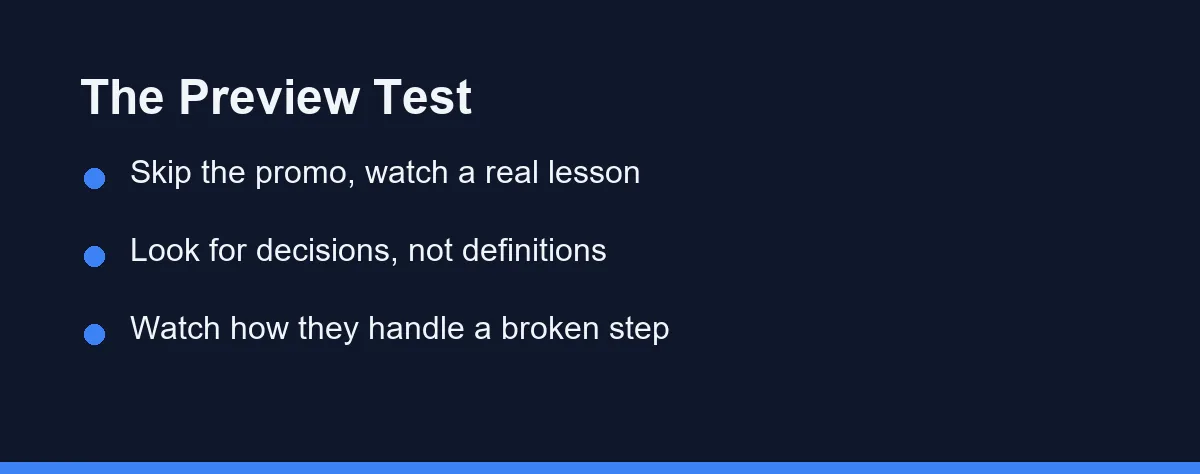
Nearly every platform offers free preview lessons, and most buyers watch the promotional video instead. The promo is produced by a marketer, and a lesson is produced by the teacher.
Pick a lesson from the middle of the course rather than the introduction. Introductions are rehearsed, and module four is where real teaching shows.
Watch for three specific things. The instructor builds or demonstrates something concrete, explains why they chose one approach over another, and keeps going when something breaks on screen.
The failure mode is easy to spot once you look for it. Definitions read aloud from slides, no decisions explained, and every example working perfectly on the first attempt.
Five Claims Worth Verifying Away From the Course Page

Course pages are sales pages, and everything on them was written to sell. The table below covers the claims that appear most often and what each one is worth.
| Claim on the page | What it can mean | How to verify in five minutes | What a failed check looks like |
|---|---|---|---|
| Senior engineer at a large company | Anything from ten years to one internship | Search for a professional profile and match the dates | No profile, or dates that contradict the page |
| Certified in the subject | Current, expired, or a different vendor entirely | Ask for the credential ID and check the vendor register | Refusal, or a credential that expired years ago |
| Trusted by Fortune 500 teams | A single corporate client, or a logo used loosely | Look for a named case study or a public reference | Logos with no client, project, or date attached |
| Bestselling instructor | High enrollment, often coupon driven | Compare paid reviews against total students | Huge student count with very few detailed reviews |
| Updated for this year | New title, or genuinely rebuilt lessons | Check lesson dates and the changelog on the page | Only the title and thumbnail changed |
The last row deserves its own habit, because it is the most common trick in course marketing. Our guide to telling whether an online course is outdated shows exactly which timestamps to trust.
A refusal to answer a direct question about credentials is itself informative. Instructors who hold the credential produce it immediately, since it takes one line to do so.
What Counts as a Public Trail
The phrase sounds vague until you list what actually qualifies. A public trail is work someone else could have refused to publish, which is why it carries weight that a course page cannot.
Strong evidence looks like this in practice.
- Code you can read. A repository with commits spread over years, not one dated the week the course launched.
- Writing with a date on it. Articles, documentation, or a book where the publisher took a risk on the author.
- Recorded talks. Conference organizers screen speakers, and the video shows you the teaching style for free.
- A register entry. Licenses, accreditations, and credential IDs that a third party maintains and can revoke.
- Named client work. A case study with a company, a project, and a year attached to it.
Weak evidence has a shape too, and it usually involves borrowed authority. Company logos with no project attached, a follower count, a course page that links only to other courses.
Absence is not proof of a fraud. Plenty of capable practitioners work under agreements that keep their output private, and for those instructors the preview and the discussion board carry the whole decision.
Running the Check on a Certification Course
Certification courses deserve a stricter process, because a mismatch costs you an exam fee as well as the course price. The vendor publishes objectives, and that document is the only authority that matters.
Download the current objectives and note the version code and the domain weightings. Vendors revise these on a cycle, and courses often keep selling against the retired version for a year afterward. CompTIA, for example, releases new exam versions approximately every 3 years and keeps the old one available for at least 6 months.
Open the course curriculum beside it and check three things. Whether every domain appears, whether the time spent roughly tracks the weightings, and whether the version code is named anywhere on the page.
A course that spends most of its runtime on the domain the instructor enjoys is a real risk. You will feel prepared and then meet a section of the exam nobody covered.
Read the Questions Before You Read the Reviews
The discussion board is the least polished part of any course listing, which is why it is the most useful. Reviews are written in the first flush of enthusiasm, and questions are written when someone is stuck.
Sort by recent and look at the last 90 days. Two things matter more than the content of the answers.
The first is whether the instructor answers at all, rather than a teaching assistant or another student. The second is whether hard questions get real answers rather than a link back to a lesson the person already watched.
An abandoned board tells you what the next year will look like. Software changes, exam objectives change, and an absent instructor leaves you with lessons that slowly stop matching reality.
When Teaching Skill Matters More Than Field Experience
Deep expertise and good teaching are different abilities, and the gap runs both ways. A brilliant practitioner may skip the steps that trip up beginners, because those steps became automatic a decade ago.
Beginner courses reward teaching skill heavily. Sequencing, examples, and patience with the boring parts decide whether you finish, and finishing is the entire point of buying the course.
Advanced courses flip the balance. When you already know the fundamentals, you are buying judgement, and judgement comes from someone who has shipped the thing in production.
Certification courses answer to a third master entirely. The vendor publishes exam objectives with weighted domains, and the only question that matters is whether the syllabus covers them in the current version.
Which Check Fits the Course You Are Buying
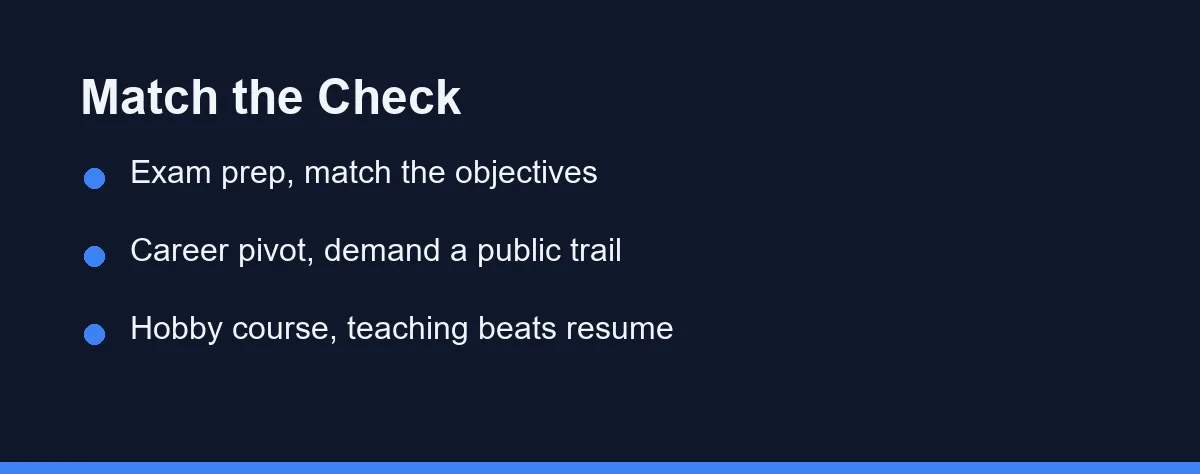
The certification candidate: Compare the syllabus line by line against the vendor exam objectives. An instructor who lists the domain weightings on the course page has read the objectives, and one who does not may be teaching the previous version.
The career changer paying real money: Demand a public trail. A repository, a portfolio, published writing, or recorded talks let you judge the work directly instead of trusting a job title.
The beginner in a new subject: Weight the preview above everything else. You cannot evaluate the accuracy of the content yet, so evaluate the clarity of the explanation and the pace.
The professional buying a narrow skill: Skip the biography and read the curriculum. For a two-hour course on one tool, coverage and recency matter more than who is teaching it.
The learner comparing a paid course to free content: Ask what the payment buys beyond the videos. Structure, feedback, and answered questions are the real product, which our comparison of online courses against free tutorials breaks down.
The buyer who is still unsure: Buy inside the refund window and treat it as an audition. Watch the hardest module in the first week and decide while returning the course is still possible.
Red Flags That Deserve a Refund Rather Than Patience
Some signals justify walking away without finishing the evaluation. Screen recordings of an interface that no longer exists is one, since it means the lessons were never rebuilt.
Answers that dodge the question is another. When a learner reports that a step fails and the reply repeats the original instruction, nobody is maintaining the course.
Reviews that all arrive in the same week suggest coordinated promotion. Genuine review flow is uneven and spread across months.
Refund windows are your protection here, and they are shorter than most people assume. Check the exact terms for your platform before buying, since our comparison of course refund policies shows how much the rules vary between them.
Buy the Teaching, Not the Biography
The instinct to check credentials is right, and the usual execution is backwards. People read the biography carefully and skip the free lesson, when the lesson is the only direct evidence available.
Reverse the order. Watch ten minutes of teaching, verify one or two claims outside the platform, and read the recent questions to see whether anyone is still home.
Twenty minutes of checking is a fair price for a course you may spend forty hours inside. The certificate at the end is worth something, and our guide to checking whether a certificate is legitimate covers that half of the decision.
A qualified instructor still cannot tell you how many of those forty hours belong in video at all. Practice tests or a video course looks at what each format is good for when a certification exam is the goal.
FAQ
What is the fastest way to judge an online course instructor?
Watch ten minutes of an actual lesson rather than the promotional video. A qualified instructor builds something on screen, narrates the decisions, and recovers when a step goes wrong. A weak one reads slides and never leaves the happy path.
Does a high student count mean the instructor is good?
Barely. Enrollment counts include free coupon signups, bundle purchases, and students who never opened lesson one. A course with 400 students and detailed recent questions often teaches better than one with 400,000 and a silent discussion board.
How do I verify an instructor claims to work at a big company?
Check the work rather than the title. Look for a public trail such as a code repository, published writing, conference talks, or a license you can look up in a public register. Job titles on a course page are self-reported and nobody checks them.
Does the instructor need a certification to teach a certification course?
For exam preparation it matters a great deal. Compare the syllabus against the current exam objectives published by the certifying vendor, because objectives change and older courses keep selling under the same name.
What should I do if the instructor turns out to be weak?
Use the refund window as your real evaluation period. Watch the hardest module first, not the introduction, and decide before the window closes rather than after the course sits untouched for two months.
Sources
- CompTIA: Certification exam development lifecycle — checked 2026-10-15
Some links may be affiliate links. We may earn a commission at no extra cost to you.
How this article was made: it was drafted with AI assistance from the official sources listed above, and its figures were checked against those pages on the dates shown. It is not based on personal hands-on testing.
Comments
Post a Comment