Online Course vs YouTube Tutorials: Which Actually Teaches You a Skill?
Two Front Doors, One Free and Endless
For most people, start free on YouTube to explore, then pay for a structured course once the interest lasts. If you reliably finish self-directed projects, free video may be all you need. If you stall without deadlines and feedback, those are what the course fee buys.
Every skill worth learning now has two front doors. One charges money and hands you a syllabus. The other is free, endless, and one search away.
The awkward part is that the free door often contains the same material. Harvard publishes CS50 lectures on YouTube, and freeCodeCamp posts multi-hour curricula that would cost real money elsewhere.
So the honest question is not which source has better information. It is which one gets you to competence, given how you actually behave when nobody is watching.
This guide compares the two paths on the things that decide outcomes: sequencing, feedback, accountability, and proof. It also names the situations where paying is straightforwardly a waste.
Free Wins on Exploring, Paid Wins on Finishing

YouTube wins on cost, breadth, and speed of exploration. Nothing beats free when you are still deciding whether a field interests you at all.
Structured courses win on sequencing, graded feedback, and accountability. Someone has ordered the topics, and something tells you when your answer is wrong.
The deciding variable is you rather than the platform. A learner who reliably finishes self-directed projects extracts more from free video than from a course they abandon in week three.
For most people the practical answer is both, in order. Explore on YouTube, commit to a course once the interest survives a few weeks, and build unguided projects throughout either path.
What YouTube Actually Does Well
Breadth is the obvious strength. Almost any topic, framework, or tool has a walkthrough, often published within weeks of a release.
Currency is the underrated one. Video creators update far faster than course platforms, so a fast-moving tool is often better covered on YouTube than in a paid curriculum written a year ago.
Cost changes the risk calculation entirely. Abandoning a free playlist after two videos costs nothing, which makes exploring three unrelated fields perfectly rational.
Some channels also carry genuine institutional weight. The freeCodeCamp channel publishes full certifications worth of material, and university lecture series sit alongside hobbyist content at the same price of zero. freeCodeCamp says each of its free certifications takes about 300 hours of self-paced work.
What a Structured Course Actually Buys
The video is rarely the product. Sequencing, assessment, and deadlines are.
Sequencing removes a decision you are not equipped to make. A beginner cannot know which topic comes next, and a curriculum encodes that judgment from people who teach the subject repeatedly.
Assessment closes the feedback loop. Quizzes, auto-graded assignments, and reviewed projects tell you that you misunderstood something, which passive watching never does.
Accountability supplies the pressure most learners need. Deadlines, cohorts, and sunk cost all increase completion, and our comparison of free vs paid online courses covers how much paying up front changes follow-through.
Credentials round it out. A certificate from Coursera, edX, or a Google career program gives an employer something to verify. Our guide on whether online certificates help get a job explains how much weight that actually carries.
The Failure Mode Nobody Warns You About
Both paths share one enemy, and it has a name in developer circles: tutorial hell.
The loop is easy to enter. You follow along with a video, the code works, and the session feels productive. Then you open an empty file and cannot start.
The cause is passive consumption. Watching someone else solve a problem builds recognition, not recall, and recognition collapses the moment the guardrails disappear.
Free video makes this loop cheaper to stay in, since there is always another tutorial. A paid course with graded projects forces the exit earlier, which is a large part of what the money buys.
The fix works on either path. After each topic, build something the tutorial did not cover, and stay with it until it works. Our look at certificates vs portfolio projects explains why that output matters more than either credential.
Your Finished-Project Count Predicts the Outcome
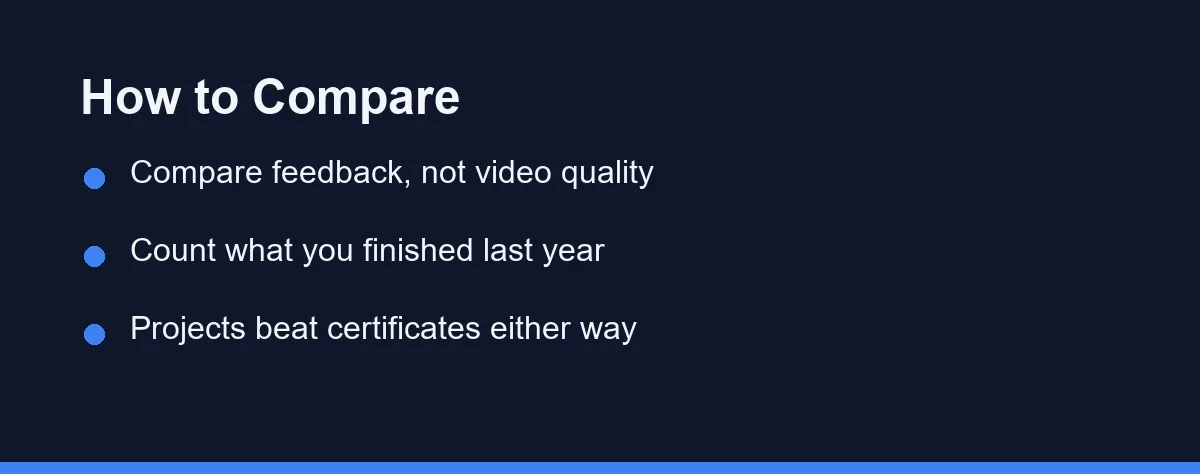
Count how many self-directed projects you finished in the last year. That number predicts your outcome better than any platform review.
Check whether the material has an assessment step. Videos with no exercises leave you unable to tell competence from familiarity.
Look for a defined endpoint. A playlist with no finish line invites drift, while a curriculum with modules gives you a visible position on the path.
Consider how fast the subject moves. A stable fundamental such as statistics or SQL suits a structured course, and a framework that ships breaking changes every quarter suits video.
Finally, ask what proof you need at the end. Career changers usually need something to show, and hobbyists usually do not.
Where the Two Paths Actually Diverge
The table compares the two paths across what actually determines results.
| Factor | YouTube tutorials | Structured online course |
|---|---|---|
| Cost | Free | Subscription or per-course fee |
| Topic sequencing | You assemble it | Designed by an instructor |
| Feedback on your work | None | Quizzes, graded projects, or review |
| Accountability | Entirely self-supplied | Deadlines, cohorts, sunk cost |
| Currency on fast-moving tools | Excellent | Often lags a release cycle |
| Verifiable credential | None | Certificate an employer can check |
| Risk of tutorial hell | High | Lower with graded projects |
| Best fit | Exploring and topping up | Committing and finishing |
The feedback row carries the most weight. It is the single thing free video structurally cannot provide, and it is what turns watching into learning.
Notice that the cost row understates the real price of free. Time spent on a path you abandon is the expensive part, and no platform refunds it.
Three Questions That Settle It
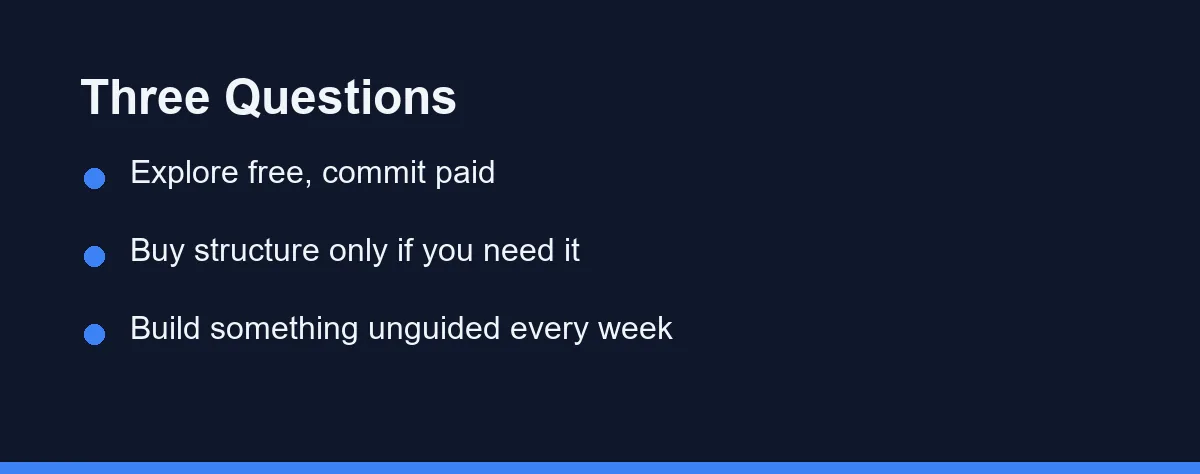
Three questions settle it.
First, are you exploring or committing? Exploration belongs on YouTube every time, because the whole point is cheap abandonment. Commitment justifies paying for sequence and feedback.
Second, do you finish things without external pressure? An honest no argues for a course with deadlines, and an honest yes means free material will probably serve you fine.
Third, does anyone need to verify this later? A career changer benefits from a credential and a portfolio. Someone learning for their own projects needs neither.
If the answers conflict, follow the second one. Discipline is the constraint that platform choice cannot fix, and matching the format to your real habits beats matching it to your intentions.
What You Are Paying For Is Sequencing and Feedback
Online learning pricing shifts with promotions and platform strategy, so treat these bands as rough guidance as of 2026. Confirm current pricing on each platform’s official site.
| Option | Rough cost | What you generally get |
|---|---|---|
| YouTube | Free | Full lectures, walkthroughs, no feedback |
| Marketplace course | ~$15 to $90 on sale | One instructor, lifetime access, light grading |
| Subscription platform | ~$20 to $60 per month | Broad catalog, guided paths, certificates |
| Professional certificate program | ~$40 to $60 per month | Structured multi-course track, employer recognition |
| University-affiliated program | Several hundred and up | Graded work, instructor contact, stronger credential |
The marketplace row offers the best value for a specific, narrow skill. Waiting for a sale is standard practice, since list prices there rarely hold.
Subscriptions reward learners who study continuously and punish those who stop. Cancelling after one month is a real option, and our Coursera Plus vs paying per course comparison covers when the subscription wins.
The two upper tiers buy recognition as much as instruction. Pay for them when a hiring manager will see the name, and skip them when only your own projects will.
Which Learner Fits Which Path
The curious explorer: Stay on YouTube entirely. Sample three fields for a month each, and spend nothing until one of them still interests you afterward.
The career changer targeting a first tech job: Buy a structured program and build a portfolio alongside it. The credential opens a screening step, and the projects carry the interview.
The professional adding one specific tool: Use YouTube and official documentation. You already have the surrounding context, and a full course would repeat what you know.
The learner who abandons everything: Pay for a cohort-based course with fixed deadlines. The external pressure is the product, and free material has already failed you.
The student on a strict budget: Combine freeCodeCamp-style free curricula with unguided projects. Add a single paid certificate later, only if a specific employer values it.
The parent or shift worker with irregular hours: Choose self-paced paid material over a cohort. Deadlines you cannot meet create guilt rather than progress, and our free vs paid online courses guide covers that tradeoff further.
Equating Hours Watched With Skill
Do not equate hours watched with skill gained. Recognition feels like competence until you face an empty file.
Do not buy a course to fix a motivation problem you have not diagnosed. Paying raises the stakes without adding the structure a cohort provides.
Do not collect certificates instead of building things. A portfolio survives every hiring trend, and a badge list rarely does.
Do not use a paid course for a tool that changes every quarter. The curriculum will lag, and the comments section will contradict the video.
Do not abandon free material out of embarrassment. Some of the strongest curricula on the internet cost nothing, and their graduates get hired.
The Gap Was Never Information Quality
YouTube and paid courses are not competing on information quality. Both contain excellent teaching, and the gap sits in sequencing, feedback, and pressure.
Free video wins whenever exploration, currency, or narrow top-up learning is the goal. Structured courses win when you have committed and need someone to order the path and grade the work.
The deciding factor is your own track record with unsupervised learning. Judge it by what you finished last year, not by what you plan to do this year.
Whichever path you take, the output is what proves the learning. Build something unguided every week, and let the certificate be a footnote to the work.
That track record also decides the next question, once you have ruled tutorials out. A paid course can run on your own clock or on a fixed timetable with classmates, and self paced against cohort based study weighs which structure actually gets finished.
Once the format is settled, how fast you run the video becomes its own decision. What survives at 2x playback has the study numbers and the point where comprehension starts to slip.
The same track-record test applies to rebuilding a school subject, where free material is abundant. For math specifically, Brilliant versus Khan Academy compares a free curriculum with a paid interactive app.
FAQ
Can YouTube teach a skill as well as a paid online course?
For learning the material, often yes. YouTube hosts full university lectures and complete curricula, including Harvard's CS50 and the freeCodeCamp channel. What it lacks is sequencing, graded feedback, and a credential an employer can verify.
What does a paid course give you that free videos do not?
The structure and the accountability, not the information. A course orders the topics, sets deadlines, grades your work, and tells you when you are wrong. Search results cannot do any of that, and self-directed learners have to supply it themselves.
Do employers care about an online course certificate?
Rarely on its own. Most employers treat a certificate as supporting evidence rather than proof, and they weigh portfolio work more heavily. A certificate helps most when it comes with projects you can show and discuss.
Should I start with YouTube or go straight to a paid course?
Use YouTube to explore a field cheaply and confirm your interest. Switch to a structured course once you commit, because that is the stage where sequencing and feedback start to matter more than breadth.
What is tutorial hell and how do I avoid it?
Tutorial hell is the loop of following along with videos, feeling productive, and being unable to build anything alone. It comes from passive watching without independent practice. Building something unguided after each topic is the standard way out.
Sources
- Harvard CS50x: Introduction to Computer Science (OpenCourseWare) — checked 2026-10-15
- freeCodeCamp: About — checked 2026-10-15
Some links may be affiliate links. We may earn a commission at no extra cost to you.
How this article was made: it was drafted with AI assistance from the official sources listed above, and its figures were checked against those pages on the dates shown. It is not based on personal hands-on testing.
Comments
Post a Comment