CompTIA Security+ vs Google Cybersecurity Certificate for a First Security Job

The Question Behind The Question
Anyone searching for this comparison is usually asking something narrower. They want to know which one a hiring manager will actually recognise on a résumé with no security experience behind it.
The two credentials are not competing products, despite sitting in the same search results. One is an exam you sit under supervision, and the other is a training programme you work through at your own pace.
That difference decides almost everything else, including what each one is worth in a job application. It also explains why the sensible answer for many beginners is a sequence rather than a choice.
Two Credentials, Two Different Jobs
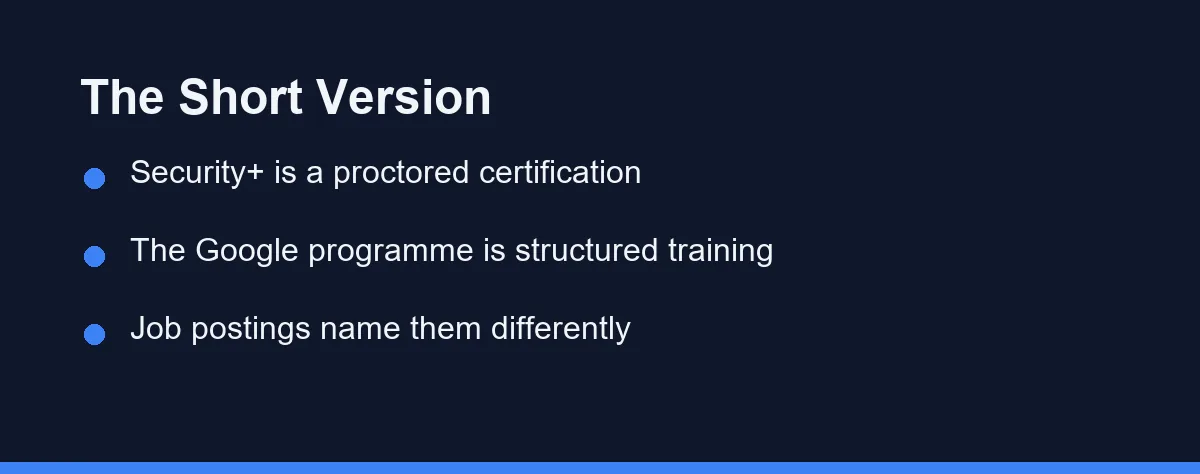
CompTIA Security+ is a vendor-neutral certification. You study whatever material you like, then sit a proctored exam that includes performance-based questions as well as multiple choice.
The Google Cybersecurity Certificate is a set of courses delivered through Coursera. You work through videos, readings, and guided labs, and you finish with a certificate of completion rather than a proctored result.
Employers read those two things differently. A certification asserts that an independent body tested you on a fixed set of objectives, while a completion certificate asserts that you finished the material.
Neither statement is worthless, and neither is proof that you can do the job. Our guide on certificates versus portfolio projects covers what closes that final gap.
What Each One Actually Teaches
The Google programme starts from zero and assumes no technical background. It moves through security concepts, network basics, Linux and SQL fundamentals, Python scripting, and a guided tour of detection tooling.
That breadth is the point. It is designed to make someone from an unrelated career comfortable with the vocabulary and the tools before they meet either an exam or an interview.
Security+ assumes you already have some of that footing. The objectives span threats and attacks, architecture, implementation, operations and incident response, and governance and risk.
The exam also tests judgement rather than recall alone. Performance-based questions put you in a scenario and ask what you would configure or investigate, which is harder to bluff than a definition.
Side By Side On What Employers Check
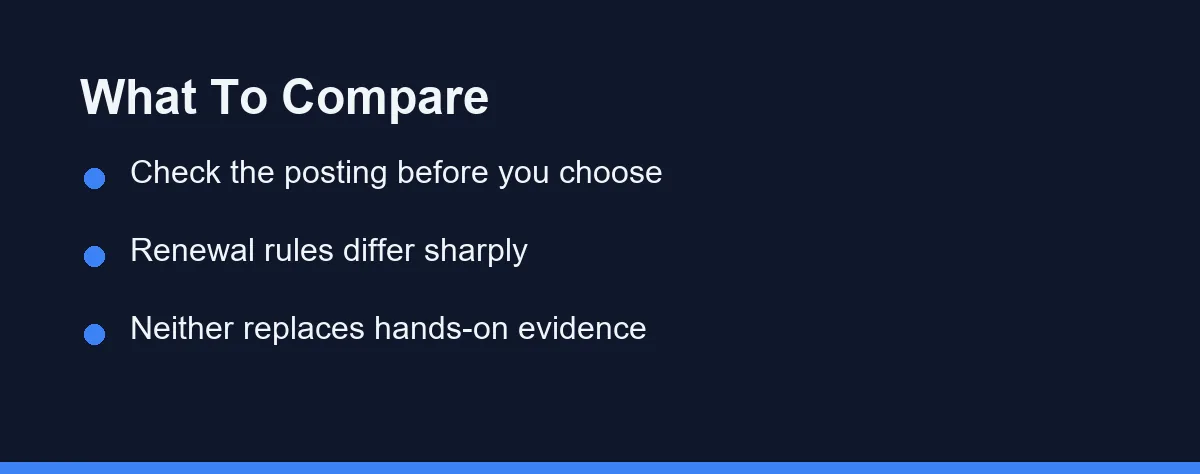
Programme content and exam objectives change over time, so confirm current details on each provider’s own site before committing.
| Factor | CompTIA Security+ | Google Cybersecurity Certificate |
|---|---|---|
| What it is | Vendor-neutral certification | Structured training programme |
| Assessment | Proctored exam, performance-based questions | Course quizzes and guided labs |
| Named in job postings | Frequently, by name | Occasionally, usually as a nice-to-have |
| Defence and government roles | Recognised as a baseline certification | Not a substitute for a named certification |
| Renewal | Fixed cycle, continuing education or retake | None, it does not expire |
| Assumed starting point | Some IT or networking exposure helps | None, built for complete beginners |
| Hands-on tool exposure | Limited, unless you build a lab | Guided labs across several tools |
| Realistic effort | Focused study over weeks or months | Steady part-time study over months |
Read the third and fourth rows together, because they carry most of the hiring weight. A credential that appears in the posting text clears automated screening in a way that a training certificate often does not.
The renewal row cuts the other way. Security+ lapses without continuing education, and our explainer on how IT certification renewal works sets out what that commitment involves.
The Cost Comparison Nobody Runs Properly
Comparing a single exam fee with a monthly subscription is the wrong arithmetic. The exam fee is one payment, while a subscription-based programme costs whatever your finishing pace turns out to be.
Someone who completes the Google programme quickly pays a fraction of what someone who stretches it across a year pays. Your realistic weekly study time is therefore part of the price, not separate from it.
Security+ has its own hidden costs. Study materials, practice exams, and a retake if the first attempt fails all sit on top of the headline fee, and retakes are common.
Both providers publish current pricing on their official sites, and both run regional and promotional variations. Confirm the figures on the CompTIA site and the Google Career Certificates site rather than relying on any number quoted elsewhere, as of 2026. Our breakdown of the real cost of an IT certification covers the extras people forget.
How Long Each One Really Takes
Published estimates assume a study pace that most working adults cannot hold. Treat them as a floor rather than a forecast.
The Google programme is paced in weekly chunks, and finishing on schedule means protecting several evenings every week without exception. Miss a fortnight and the subscription clock keeps running while your progress does not.
Security+ preparation is harder to estimate because it depends entirely on what you already know. Someone with two years of help desk work behind them covers the objectives far faster than someone meeting subnetting for the first time.
Book the exam before you feel ready, once you can pass practice tests consistently. A fixed date converts open-ended study into a project with an end. Our guide to studying for a certification exam while working full time covers how to structure those weeks.
How Each One Reads On A Résumé
Placement changes how much either credential does for you. A certification belongs on its own line near the top, with the awarding body and the year it was earned.
A training certificate reads better as evidence inside a skills or projects section. Listing it beside genuine certifications invites a comparison it will lose, while pairing it with what you built invites the opposite.
Be precise about the wording, because recruiters in this field notice the difference. Describing a course completion as a certification is the sort of overstatement that ends an interview early.
Name the tools you touched rather than the courses you finished. A line describing what you configured, queried, or investigated survives screening better than a list of programme titles. Our advice on listing an online course on your résumé applies directly here.
Which One Fits Your Starting Point

The career changer with no IT background: Start with the Google programme. Security+ objectives assume a working vocabulary that takes months to build otherwise, and skipping that step usually means a failed first attempt.
The help desk or support technician: Go straight to Security+. You already have the networking and troubleshooting exposure the exam assumes, and the certification is what unlocks the next posting.
The applicant targeting a defence contractor or government role: Security+, without hesitation. Baseline certification requirements name specific certifications, and a training certificate does not satisfy them.
The student with time but little money: Work through free material alongside the Google programme’s structure, then budget for the Security+ exam as a single planned expense. Financial aid on the course platform is worth checking first.
The applicant who has failed Security+ once: Do not immediately rebook. Use the Google programme or a lab-heavy course to fix the specific domains you lost points on, then return to the exam.
The person still unsure whether security is the right field: Start the Google programme and treat the first two courses as a trial. Discovering the work does not suit you is far cheaper before an exam booking than after one.
Doing Both, In The Right Order
For most beginners the two are complementary, and the sequence matters more than the choice. The training programme builds the foundation, and the certification converts it into something a recruiter’s filter recognises.
Running them in parallel is possible but rarely efficient. Exam preparation rewards focus, and splitting attention across a broad course and a fixed objective list tends to slow both.
There is one exception worth noting. If your target employer has already named Security+ in the posting, go to the exam directly and use the course only to patch weak domains.
Check whether the training provider offers any discount toward a certification exam for programme completers. These arrangements change, so verify the current terms on the official site rather than trusting a forum post. Our review of whether the Google Cybersecurity Certificate is worth it goes deeper on that programme alone.
What Neither Credential Gives You
Both routes leave the same gap, and interviewers know exactly where to press. Neither one shows that you have investigated an alert, read a log that made no sense, or explained a risk to someone who did not want to hear it.
Closing that gap does not require another purchase. A small home lab, a few documented investigations, and a written explanation of what you found will do more for a first interview than a third credential.
Capture-the-flag events and public write-ups serve the same purpose. They give you specific stories to tell, which is what turns a certification into an offer.
Plan for that work from the start rather than after the certificate arrives. Our comparison of where certifications sit against a degree puts the whole stack in context.
Pick The One Your Next Job Posting Names
The honest answer depends on where you are starting and what you are applying for. Security+ is the credential the industry names, and the Google certificate is the on-ramp that makes it reachable for someone starting from nothing.
If you have IT experience, book the exam. If you do not, spend the months building the foundation first, then book it.
Either way, treat the credential as the entry ticket rather than the qualification. The applicants who convert these programmes into jobs are the ones who paired them with something they built and can talk about in detail.
Confirm current objectives, fees, and renewal rules on each provider’s official site before you commit, since both change between versions.
A third entry option, ISC2 Certified in Cybersecurity, lost its free exam in 2026. Our look at whether ISC2 Certified in Cybersecurity is worth it now compares its $199 fee and $50 yearly upkeep with these two.
Once Security+ is done, the next CompTIA step splits into a defensive track and an offensive one. Our guide to choosing CySA+ or PenTest+ after Security+ compares their 165-minute exams, domain weights and the CySA+ V3 retirement date.
FAQ
Is the Google Cybersecurity Certificate the same as CompTIA Security+?
They answer different questions for an employer. Security+ is a proctored, vendor-neutral certification that many job postings name directly. The Google certificate is a self-paced training programme that teaches the groundwork, and it carries no exam of the same weight.
Should I do the Google Cybersecurity Certificate before Security+?
For most beginners, yes, and it is the common sequence. The Google programme covers the vocabulary, tools, and habits that make the Security+ objectives readable rather than intimidating. Going straight to the exam works if you already have IT support or networking experience.
Do employers accept the Google Cybersecurity Certificate instead of a certification?
Some do, particularly smaller employers and apprenticeship-style programmes. Government and defence contractor roles are the clearest exception, since baseline certification requirements name specific certifications rather than training courses. Check the individual posting rather than assuming.
Does Security+ expire, and does the Google certificate?
Security+ requires renewal on a fixed cycle, usually through continuing education credits or by retaking the current exam version. The Google certificate does not expire, because a completed course cannot lapse. That difference cuts both ways, since a credential that never expires also never proves you are current.
Will either credential get me hired without experience?
Neither one does on its own. Both give you material for a résumé and interview answers, and both leave the practical gap that hiring managers probe. Building a small home lab and documenting what you did closes more of that gap than a third credential.
Sources
- ISC2: One Million Certified in Cybersecurity program — checked 2026-10-10
Some links may be affiliate links. We may earn a commission at no extra cost to you.
How this article was made: it was drafted with AI assistance from the official sources listed above, and its figures were checked against those pages on the dates shown. It is not based on personal hands-on testing.
Comments
Post a Comment