Certificate vs Portfolio Projects for a First Tech Job
The Argument Every Career-Change Forum Repeats
For most people chasing a first tech job, the answer is one recognized certificate to clear screening, then three or four serious projects. The certificate gets you past keyword filters. The projects carry the interview, where you need specific work to talk through. Small employers tend to weigh the projects most, so lean on the portfolio when you target them.
Every career-change forum runs the same argument. One side says nobody looks at certificates, and the other says you cannot get past the application form without one.
Both camps are describing something real. They are simply describing different stages of the same hiring process, and neither generalises to the whole thing.
A hiring pipeline has a filter and a judgement. The filter is automated or clerical and runs on keywords and credentials, while the judgement is a human deciding whether you can do the work.
The sections below separate those two stages and show which asset works at each one, for anyone with limited time and money.
One Certificate to Clear Screening, Then Build
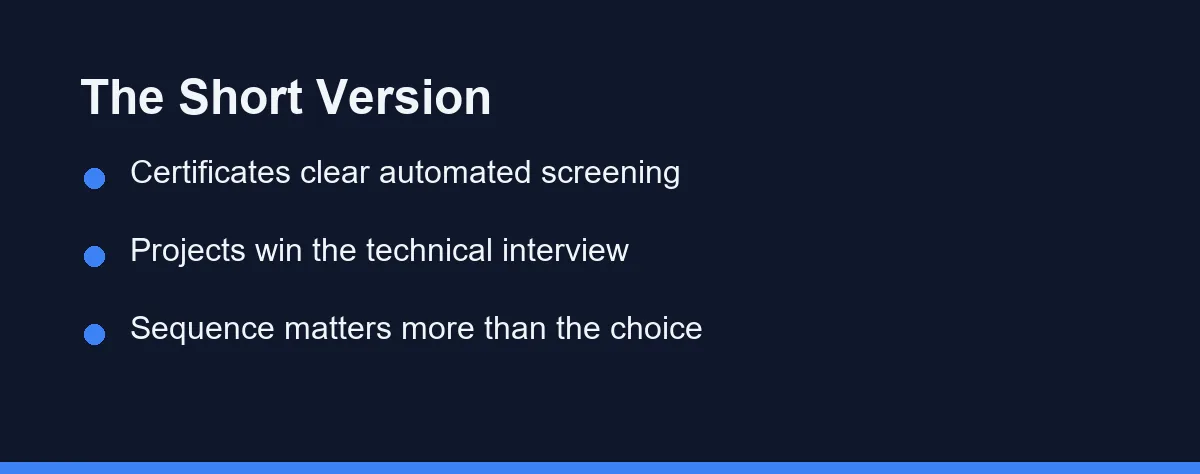
Get one recognised certificate to clear screening, then put the rest of your hours into three or four serious projects. That order beats either extreme for almost every entry-level candidate.
The certificate is a ticket, not an argument. It signals that you completed structured study and it fills the credential field that automated systems check.
The portfolio is the argument. It is the only thing in your application that demonstrates you can take an ambiguous problem and produce something that runs.
Where candidates go wrong is stacking certificates. The second and third credential add far less than the first, while a single strong project keeps paying off in every interview. Our do online certificates help get a job guide covers where that value actually comes from.
Read Ten Postings in Your Own City
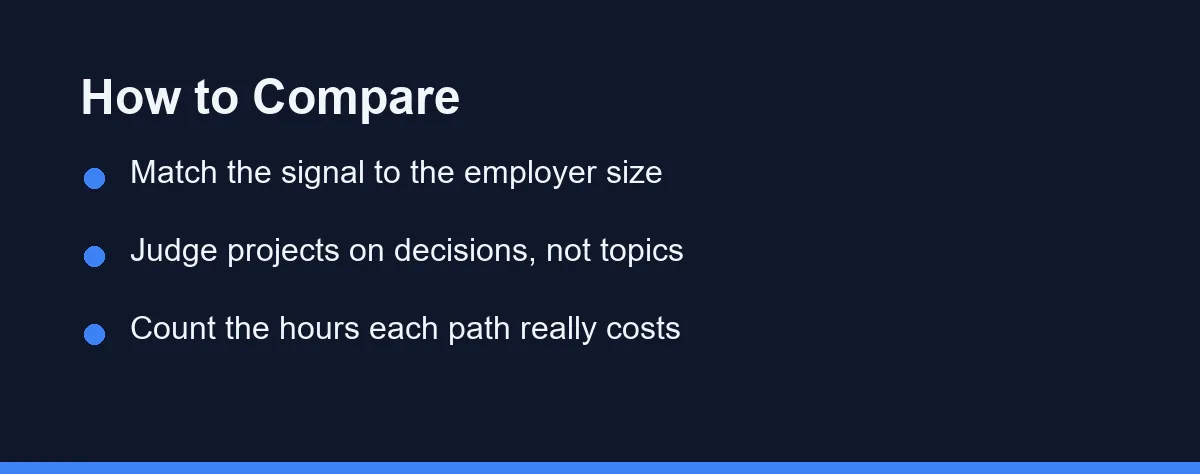
Start by reading ten real job postings in your target role and city. The requirements section tells you whether that market screens on credentials at all.
Notice the employer size pattern. Large organisations and staffing agencies filter systematically, and small companies typically have a founder or lead reading applications directly.
For certificates, look at whether the issuer is recognised outside its own ecosystem. A credential from a major cloud vendor or a well-known platform carries further than one from a provider a recruiter has never seen.
Check whether the certificate includes assessed work rather than video completion. Programmes ending in a graded project give you a portfolio piece and a credential from the same hours.
For projects, judge them on decisions rather than topic. A basic application where you can explain every architectural choice beats an ambitious one you assembled from copied snippets.
Finally, look at whether the project has a user. Something built because a friend, a club, or a small business asked for it carries a credibility that a self-assigned exercise never does.
Four Situations That Cover Most People
The right balance depends on which door you are trying to open. Four situations cover most people making this decision.
The Complete Career Changer
If you have no technical background at all, start with the certificate. You need the structure, and the credential does real work in explaining a resume gap to a recruiter.
The gain is legitimacy at the screening stage. It answers the obvious question about why a former teacher or nurse is applying to a developer role.
The limitation arrives quickly. Once you have one credential, further certificates mostly signal that you are still studying rather than building. Our are coding bootcamps worth it analysis is worth reading before you spend more on structured study.
The Self-Taught Builder
If you already ship things but have no formal credential, add exactly one certificate and stop. You are strong where it counts and weak only at the automated filter.
The gain is access. A single recognised credential gets your projects in front of the person who will appreciate them.
The caution is time allocation. Do not restart from beginner material you already know, and pick the certificate that certifies what you can already do.
The Recent Non-Technical Graduate
If you hold a degree in another field, your position is stronger than you think. The degree covers the general education filter, so a targeted certificate plus projects is enough.
The gain is combination. Domain knowledge plus technical projects is a genuinely differentiated profile, especially in data, product, and internal tooling roles.
The caution is drifting generic. Build projects in your former field rather than generic clones, because that intersection is your actual advantage.
The Candidate Targeting a Specific Employer
If you have a particular company in mind, let their posting decide. Some list a named certification explicitly, and in those cases the credential is not optional.
The gain is precision. Matching a stated requirement removes the guesswork from the whole decision.
The caution is over-indexing on one employer. Confirm the requirement appears across the market before you build a plan around a single posting.
What Each Asset Actually Does in Hiring
The table below compares the two assets on what they actually do in a hiring process. Individual employers vary, so verify against postings in your own market.
| Factor | Certificate | Portfolio Projects |
|---|---|---|
| Clears automated screening | Strong, that is its main job | Weak, rarely parsed by filters |
| Convinces a hiring manager | Limited on its own | Strong, the primary evidence |
| Time cost | Fixed and predictable | Open-ended, expands to fit |
| Money cost | Subscription or exam fee | Mostly free beyond hosting |
| Proves current skill | Indirectly, at a point in time | Directly, inspectable today |
| Gives interview material | Thin, mostly curriculum recall | Deep, every choice is a question |
| Ages | Fades as versions change | Improves as you extend it |
| Best stage | Application and screening | Interview and technical round |
| Signals to small employers | Modest | Very strong |
Look at the interview material row closely. A technical conversation runs on specifics, and only one of these two columns supplies them.
Look at the ageing row second. A certificate earned three years ago says less each year, while a project you keep extending gets more persuasive.
Let the Postings Decide Before You Spend
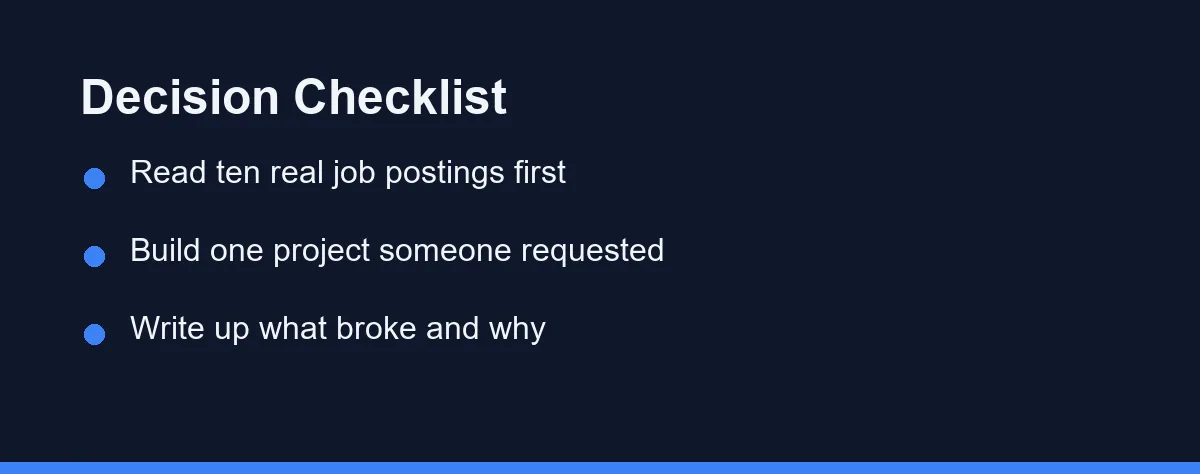
Read the postings before you spend anything. If a named credential appears in most of them, that decision is made for you.
Then set a hard budget on study hours. Give the certificate a defined block of weeks and refuse to extend it, because open-ended study is the most common way this plan fails.
Choose the certificate whose final assessment produces something you can show. Getting a credential and a portfolio piece from the same hours is the highest-leverage move available.
Next, find a real request. Ask a local business, a community group, or a friend with a spreadsheet problem, and build the thing they actually need.
Write up each project as you finish it. A short document covering the problem, your approach, what broke, and what you would change turns a repository into an interview script.
Finally, apply earlier than feels comfortable. Interview feedback tells you which gap is real, and that beats guessing from a forum argument.
Costs That Differ in Kind, Not Just Amount
Costs differ in kind rather than just amount, which is why comparing them on a single figure misleads. Confirm current pricing on each provider’s official site, as of 2026.
Certificates from major platforms are usually a monthly subscription while you study, so the total depends on how fast you finish. As of October 2026, Coursera lists Coursera Plus at $59 a month or $399 a year. Its Google IT Support certificate is listed at 3 months at 10 hours a week. Vendor certifications instead charge a one-time exam fee, sometimes with separate practice material.
Portfolio projects are close to free in cash terms. Hosting, a domain, and any paid data source are the only real line items, and free tiers cover most beginner projects.
The real cost of a portfolio is time, and it is easy to underestimate. A project worth showing typically takes far longer than the tutorial version it started as.
Budget for the write-up too. It costs an evening per project and is the part most candidates skip, which is exactly why doing it stands out. Check current platform plans on the official Coursera site, as of 2026.
Collecting Credentials Instead of Building
The first mistake is collecting credentials. After the first one, each additional certificate delays the moment you start building.
The second is a portfolio of identical tutorials. Five projects from the same course teach a reviewer nothing about your judgement.
The third is a repository with no explanation. Reviewers rarely read code cold, and without a written summary your best work looks like everyone else’s.
The fourth is hiding unfinished work. A project with a clear note about what is incomplete and why reads as honest engineering rather than failure.
The fifth is waiting until you feel ready. Readiness arrives through applying and interviewing, not through one more course.
Which Asset Fits Your Situation
The comparison table sets out the trade-offs. Here is the direct call for the situations that ask this most often.
The career changer from a non-technical field: Get one certificate first, then build three projects. The credential explains your pivot and the projects prove it.
The self-taught developer with real code: Add a single recognised certificate purely to clear filters, and spend nothing more on study.
The applicant targeting large enterprises or agencies: Prioritise the certificate. These employers screen systematically and a portfolio alone often never reaches a human.
The applicant targeting startups and small teams: Prioritise projects. A founder reading applications will open your repository before checking any credential.
The data or analytics candidate: Build projects using messy public data and document the cleaning. That specific work is what separates candidates in this field.
The candidate with very limited time: Choose a certificate with a substantial graded capstone. It is the only way to produce both assets from one block of hours.
Two Different Obstacles in the Same Process
The certificate and the portfolio are not competing answers to one question. They clear different obstacles in the same process, and skipping either one leaves a predictable failure mode.
Buy the ticket once, then spend everything else on evidence. One credential plus three genuine projects beats four certificates in almost every entry-level market.
Above all, make your projects explainable. The interview is a conversation about decisions, and the candidate who can narrate their own trade-offs wins it.
Confirm current course pricing and any named certification requirements on the official sites before committing. For related reading, see our guides on do online certificates help get a job and associate degree vs certificate for tech jobs.
If the certificate route wins for your target role, the vendor still matters. Microsoft vs CompTIA for a help desk job sets the two side by side.
A course capstone sits between those two options, since it is assigned work that you can publish under your own name. What a capstone project is worth covers what a hiring reviewer reads in one and what they skip.
Free web development curricula differ sharply in how much publishable work they leave you holding at the end. The Odin Project vs freeCodeCamp compares the two on exactly that output.
FAQ
Do employers care more about certificates or portfolio projects?
A certificate opens the screening stage and a portfolio wins the interview, so the sequence matters more than the choice. Recruiters use credentials to filter a large pile quickly, then hiring managers look for evidence you can actually build something. Candidates who only have one of the two stall at whichever stage the other one covers.
How many portfolio projects do I need for a first tech job?
Three or four projects is usually enough if they are genuinely different from each other. One that handles messy real data, one that is deployed and running, and one that solves a problem someone actually asked for will outperform ten tutorial clones.
Do tutorial projects count as portfolio work?
Tutorial projects count only when you take them somewhere new. A to-do app built from a video is invisible in a stack of applications, but the same app extended with a feature the tutorial never covered shows the judgement employers are screening for.
Can I be screened out for having no certificate at all?
Yes, and this is the main reason certificates still have value. Some larger employers and staffing firms use credentials as a hard filter in applicant tracking systems, so a portfolio never reaches a human without one. Smaller companies rarely filter this way.
Should the certificate or the projects come first on my resume?
Put the projects first on the resume and let the certificate sit in a short education line. Hiring managers scan for evidence of building, and burying your strongest asset under a credentials list wastes the space where you are most competitive.
What does a portfolio actually need to include?
A public repository, a short written explanation, and a live link if the project runs anywhere. The explanation matters more than people expect, because it is where you show what you chose, what broke, and what you would do differently.
Sources
- Coursera Plus: Plans and Pricing — checked 2026-10-15
- Coursera: Google IT Support Professional Certificate — checked 2026-10-15
Some links may be affiliate links. We may earn a commission at no extra cost to you.
How this article was made: it was drafted with AI assistance from the official sources listed above, and its figures were checked against those pages on the dates shown. It is not based on personal hands-on testing.
Comments
Post a Comment